
The Gift of the Magi - A Timeless Christmas Lesson
By: Sarah Chen Classic Tales Revived | Published on Dec 20,2025
Category Moral Stories
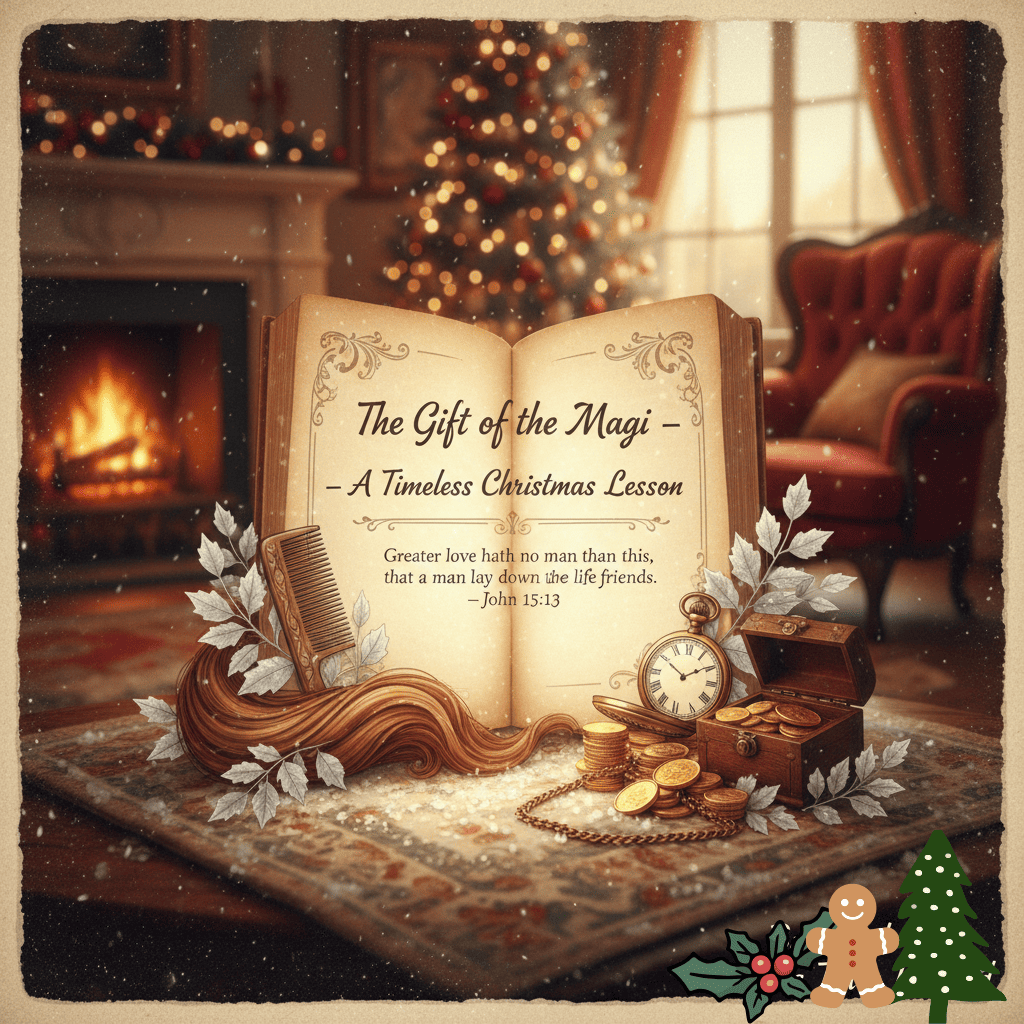
The Story
This beloved tale comes from O. Henry's 1905 short story, set in a small, humble apartment where a young couple—Jim and Della—lived with almost nothing but deep love for each other.
Christmas was approaching, and Della desperately wanted to buy Jim a worthy gift. She had only $1.87 saved, which wasn't nearly enough for anything special. Jim possessed one treasure: a beautiful gold watch that had been his father's and grandfather's before him. Della possessed one treasure: her magnificent, long brown hair that cascaded down her back.
On Christmas Eve, Della made a decision. She walked to a hair shop and sold her beautiful hair for $20. With that money, she bought Jim the perfect gift—an elegant platinum chain for his precious watch.
That evening, Jim came home to find Della with her hair cut short. He stood frozen, staring at her with an expression she couldn't quite read. Slowly, he handed her a package. Inside were the most beautiful hair combs—jeweled, pure tortoiseshell—the very combs Della had admired for months in a shop window, perfect for her long, beautiful hair.
Della understood his strange expression now. She unwrapped her gift to him—the platinum chain. Jim sat down and smiled. "Dell," he said, "I sold the watch to buy your combs."
They had each sacrificed their most precious possession to buy a gift for the other's most precious possession—gifts that were now, practically speaking, useless.
Why This Story Endures
On the surface, this seems like a sad tale of waste and irony. They sacrificed everything and ended up with gifts they couldn't use. But here's what makes this story profound: they didn't end up with nothing. They ended up with something far more valuable—the tangible proof of how deeply they loved each other.
Think about what these gifts represented. Not watches or hair or material objects. They represented the willingness to give up what they treasured most for the happiness of the person they loved. That's not foolishness. That's the purest form of love.
We live in a world obsessed with perfect gifts, perfect celebrations, perfect Christmas moments. We stress ourselves into exhaustion trying to find exactly the right present, host the perfect gathering, create the ideal holiday experience. We spend money we don't have. We accumulate things nobody needs. We miss the entire point.
The Deeper Wisdom
O. Henry ends his story by comparing Jim and Della to the Magi—the wise men who brought gifts to baby Jesus. He suggests they were the wisest gift-givers because they understood what gifts are truly about: not the object itself, but the love it represents.
The watch and the hair weren't just possessions—they were symbols of identity, family legacy, personal pride. To give those up meant giving up part of themselves. That's what made their gifts sacred.
Christmas has become so commercialized that we've forgotten this simple truth: the gift is never really the object. It's the thought, the sacrifice, the love made visible. It's the saying "I see you, I know you, I value you enough to give you something of myself."
The most precious gifts can't be bought in stores. They're made of time, attention, presence, sacrifice. They're the gift of showing up. The gift of listening. The gift of forgiveness. The gift of being vulnerable. The gift of putting someone else's joy ahead of your own comfort.
Living This Truth
This Christmas season, before you exhaust yourself and your bank account hunting for perfect presents, pause and ask: what can I give that actually costs me something real?
Maybe it's time—the gift of being fully present with someone without checking your phone. Maybe it's service—helping someone with something they've been struggling with. Maybe it's vulnerability—finally having that honest conversation you've been avoiding. Maybe it's forgiveness—releasing a grudge that's been weighing on both of you.
Maybe it's sacrificing your need to be right to preserve a relationship. Your desire to win an argument to maintain family peace. Your pride to offer a genuine apology. Your comfort zone to show up for someone who needs you.
These gifts cost you something real—ego, time, comfort, pride. And because they cost you something, they mean something. Just like Jim's and Della's gifts.
The Moral
True generosity isn't measured by price tags or Pinterest-worthy presentations. It's measured by what it costs your heart to give it.
The greatest gifts require you to give up something of yourself—your time, your ego, your comfort, your grudges, your pride. These gifts can't be returned or exchanged. They can't be compared or one-upped. They're priceless because they're personal, irreplaceable, and real.
Your Reflection Today
Who in your life could use a gift that costs you something real this Christmas? Not money—something deeper?
What could you sacrifice—a grudge, time, pride, comfort—that would genuinely bless someone you love?
What if the most meaningful Christmas you ever created came from giving what's most precious to you, not what's most expensive?
Jim and Della ended that Christmas Eve in each other's arms, laughing at the beautiful irony of their useless gifts, understanding that they'd given each other exactly what mattered most: proof that they would sacrifice anything for each other's happiness.
That's the real magic of Christmas. Not what's under the tree. What's in the heart.
Give that. Give from that. Give with that.
That's the gift that changes everything.
Amazon Affiliate Disclosure
As an Amazon Associate I earn from qualifying purchases.
Comments
No comment yet. Be the first to comment