
Toote hue dil se bhi phool khilte hain, Bas yakeen rakhna, waqt sab theek kar deta hai. Zakhm bhale gehre hon, dard bhale zyada ho, Subah phir aayegi, andhera yun hi nahi rehta hai.
By: Compiled from various sources | Published on Dec 24,2025
Category Shayari
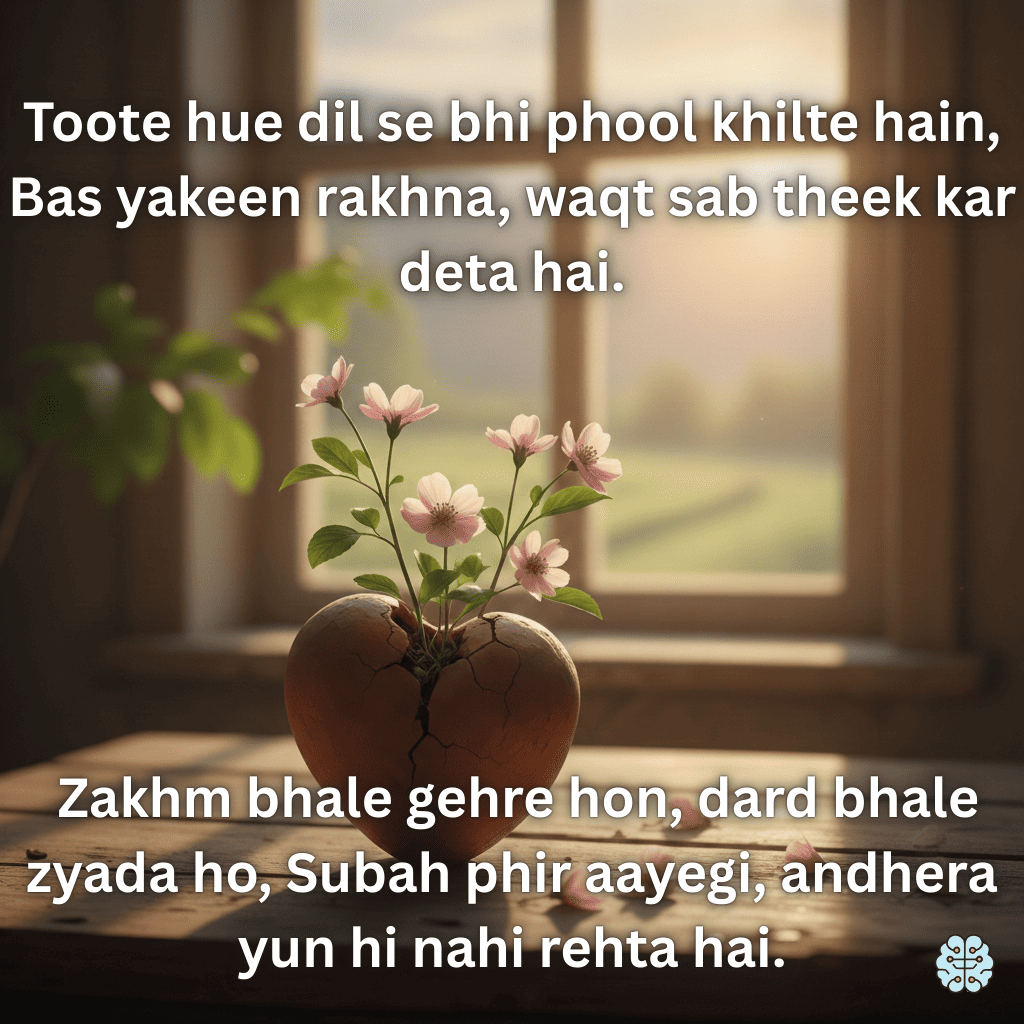
Translation: "Even from broken hearts, flowers bloom bright, Just keep faith, time will make everything right. Wounds may be deep, pain may be more, Morning will come again, darkness doesn't stay for sure."
About This Shayari
This healing shayari draws from the ancient tradition of using nature metaphors—particularly flowers and light—to express emotional recovery and hope. While not attributed to a classical poet, it echoes themes found throughout Urdu and Hindi poetry, from Mirza Ghalib's explorations of pain to Faiz Ahmed Faiz's imagery of darkness and dawn. The shayari combines two powerful promises: that broken things can still create beauty (the broken heart/blooming flower paradox) and that darkness is temporary (the night/morning cycle). These aren't just poetic devices—they're therapeutic truths dressed in beautiful language.
Why It Resonates
You're hurting right now. Maybe it's a breakup that shattered you. Maybe it's a betrayal that broke your trust. Maybe it's a loss that left a hole in your life. Maybe it's a failure that crushed your confidence. Maybe it's accumulated disappointments that have worn down your hope.
And when you're in that pain—when your heart is actually, genuinely broken—every platitude feels hollow. "Time heals all wounds." "Everything happens for a reason." "You'll be okay." These phrases feel dismissive, like people who haven't been where you are trying to comfort you with words that don't reach the depth of your hurt.
But here's why this shayari is different: it doesn't minimize your pain. "Zakhm bhale gehre hon"—wounds may be deep. "Dard bhale zyada ho"—pain may be more. It acknowledges the reality of your suffering. It doesn't tell you to just think positive or snap out of it or be grateful or any of that spiritual bypassing nonsense.
Instead, it offers something more honest: you're broken right now, and that's real. The pain is deep, and that's valid. But—and this is the hope that saves lives—broken hearts can still bloom flowers. From your shattered pieces, something beautiful can still grow.
Not because the breaking was good. Not because you "needed" this pain. Not because everything happens for a reason in some cosmic plan. But because humans have this remarkable capacity: we can transform our wounds into wisdom, our pain into purpose, our brokenness into breakthroughs.
The Psychology Behind It
There's a concept in psychology called "post-traumatic growth"—the phenomenon where people who've experienced significant trauma or loss don't just recover to their baseline but actually grow beyond it. They develop deeper relationships, greater appreciation for life, increased personal strength, spiritual growth, and recognition of new possibilities.
Research by psychologists Richard Tedeschi and Lawrence Calhoun shows that 30-70% of trauma survivors report positive changes alongside their suffering. They don't say the trauma was worth it, but they acknowledge that something unexpectedly valuable emerged from the pain.
This is the "toote hue dil se bhi phool khilte hain" phenomenon—flowers blooming from broken hearts. The breaking creates cracks through which new growth can emerge. Pain strips away what doesn't matter and reveals what does. Suffering humbles us, opens us, connects us to our own humanity and the humanity of others.
There's also neurological truth to "waqt sab theek kar deta hai" (time makes everything right). Your brain's emotional processing systems—particularly the hippocampus and prefrontal cortex—need time to integrate traumatic experiences. Initially, the amygdala is hyperactive, keeping you in high emotional distress. But over time, with processing, the distress decreases. It's not that time magically heals—it's that time allows your brain to do the healing work.
The darkness/morning metaphor isn't just poetic—it's neurobiologically accurate. Your emotional state operates in cycles. The acute pain of fresh trauma is like midnight: dark, disorienting, all-consuming. But human emotion doesn't stay at peak intensity forever. It waves. It cycles. And with each cycle, the intensity typically decreases. Morning does come.
The Deeper Meaning
This shayari is teaching something profound about the nature of healing: it's not linear, it's not optional, and it's not about returning to who you were before. It's about becoming someone new through the breaking.
The "phool" (flowers) that bloom from broken hearts aren't the same ones you had before the breaking. They're different flowers. New growth. You're not going to go back to the innocent, unbroken version of yourself—that person is gone. But you can grow into a wiser, deeper, more compassionate version who carries their scars as proof of survival, not shame of damage.
"Yakeen rakhna" (keep faith) isn't about religious faith necessarily. It's about maintaining belief in your own capacity to survive this, to eventually feel okay again, to one day look back on this pain with perspective instead of drowning in it. It's faith that you're stronger than this moment suggests, that you won't always feel this way, that healing is possible even when it feels impossible.
And the morning promise—"subah phir aayegi" (morning will come again)—isn't saying pain is temporary and you'll forget. It's saying the intensity is temporary. You'll carry the loss, the hurt, the memory. But you won't stay in this midnight darkness forever. Light returns. Not because you earned it. Not because you did everything right. But because that's how time works. Darkness, by its very nature, cannot last forever.
Living This Truth
Give yourself permission to be broken right now. Don't rush your healing. Don't let people who haven't been where you are tell you how long you should take to recover. Your wounds are deep. Your pain is real. Sit with it. Feel it. Don't bypass it.
But also—and this is crucial—start looking for the tiny flowers. Not to minimize the breaking. Not to pretend everything's fine. But to notice: Is there any small way you're growing through this? Any tiny insight you've gained? Any unexpected strength you've discovered? Any connection that's deepened through your vulnerability?
These don't justify the pain. But they prove that even in breaking, you're not just breaking. You're also becoming.
Trust time, but don't be passive. "Waqt sab theek kar deta hai" doesn't mean sit around and wait for time to fix you. It means use time wisely. Do the healing work. Go to therapy. Journal. Talk to friends. Cry when you need to. Rest when you must. Take action when you can. Process. Feel. Grow.
And on the dark nights—because they'll come, repeatedly—remember: "Andhera yoon hi nahin rehta" (darkness doesn't just stay). This isn't permanent. This isn't forever. Morning is coming. Not today maybe. Maybe not tomorrow. But it's coming.
Your Reflection Today
What broke your heart? Name it honestly. Don't minimize it. Don't rush past it. What actually hurts?
Are you giving yourself permission to be broken right now, or are you pressuring yourself to "be okay" before you're ready?
Can you see any tiny flowers blooming from the cracks? Any small way you've grown, learned, or deepened through this pain?
What does "morning" look like for you? What would it feel like to be on the other side of this darkness, not unchanged, but okay?
Here's what you need to hear today: You are broken. That's true. Your heart has shattered into pieces, your trust has been violated, your hope has been crushed. The pain is real, deep, and valid.
And—simultaneously—you are growing. Right now, in the middle of the breaking, flowers are beginning to emerge from the cracks. You can't see them yet. You might not notice them for months or years. But they're there, pushing up through the broken soil of your heart.
Time is working, even when you can't see it. Healing is happening, even when you can't feel it. Morning is approaching, even when you're still in the deepest part of night.
You won't be the same after this. The you who existed before the breaking is gone. But the you who exists after—the you who survived this, who grew flowers from their broken places, who walked through the darkness until morning came—that person is going to be remarkable.
Broken, yes. Scarred, absolutely. But blooming. But healing. But alive.
Keep the faith. Yakeen rakhna.
The wounds are deep, but flowers are coming.
The pain is real, but morning is coming.
You're broken, but you're also becoming.
And that's how healing works: not by avoiding the breaking, but by blooming through it.
Amazon Affiliate Disclosure
As an Amazon Associate I earn from qualifying purchases.
Comments
No comment yet. Be the first to comment