
Khud se milo kabhi tanhaai mein, Asli chehra dikhta hai khamoshi mein. Bheed mein kho jaate hain hum apne aap ko, Sachchi pehchaan to hoti hai apni parchhaayi mein
By: Compiled from various sources | Published on Dec 26,2025
Category Shayari
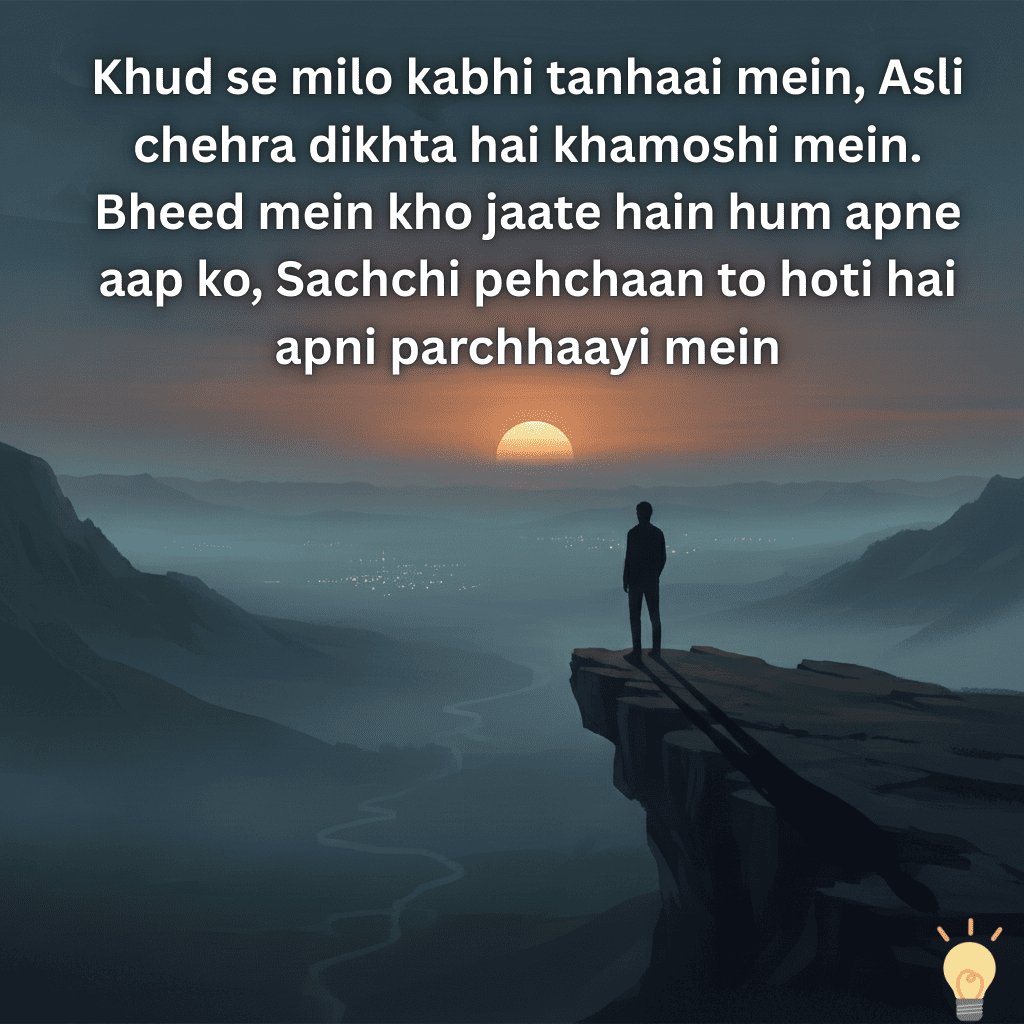
Translation: "Meet yourself sometime in solitude's embrace, The real face appears in silence's space. In the crowd we lose ourselves completely, True identity lies in our own shadow, discreetly."
About This Shayari
This introspective shayari belongs to the philosophical tradition of Urdu-Hindi poetry that explores self-knowledge, identity, and the distinction between external persona and internal truth. It echoes themes found in Sufi poetry about the journey inward, in Ghalib's explorations of self and society, and in modern existential writings about authenticity. The use of "tanhaayi" (solitude), "khamoshi" (silence), and "parchaayi" (shadow) creates a contemplative atmosphere that invites deep self-reflection. While not attributed to a classical master, it captures timeless wisdom: you cannot know yourself through others' eyes; you must turn inward.
Why It Resonates
Think about how much of your day you spend being someone for other people. You're the professional at work, wearing the mask of competence and confidence. You're the friend in your group, playing the role they expect. You're the son or daughter, the partner, the parent, performing the version of yourself that fits each relationship. You're the social media persona, carefully curating what you share.
In every interaction, you're adjusting. Moderating. Performing. Not necessarily being fake—just being the version of yourself that fits the context, that meets expectations, that maintains relationships, that keeps things smooth.
And here's what happens: you forget who you actually are underneath all those roles. You've been performing for so long, adjusting to so many different audiences, that you've lost touch with your authentic self. You know who you are in relation to others, but you don't know who you are alone.
That's why this shayari hits so hard: "Khud se milo kabhi tanhaayi mein"—meet yourself sometime in solitude. Not meet others. Not check your phone. Not distract yourself. Actually sit with yourself, in silence, alone, and ask: Who am I when no one is watching? Who am I when I'm not performing? Who am I in my shadow—in the parts of myself I don't show the world?
Because "bheed mein kho jaate hain hum apne aap ko"—in the crowd, we lose ourselves. Not dramatically. Not intentionally. Just gradually, through a thousand small adjustments, we drift away from our core until we're not even sure what that core is anymore.
The Psychology Behind It
Modern psychology has extensively studied what's called "the authentic self" versus "the performed self." Research shows that people who regularly disconnect from their authentic self experience higher rates of anxiety, depression, and general dissatisfaction—even when externally successful.
Carl Jung wrote about the "persona"—the mask we wear for different social roles—and the "shadow"—the parts of ourselves we hide or deny. The shayari's reference to finding truth in your "parchaayi" (shadow) is psychologically accurate: your deepest truth, including the parts you hide, lives in the shadow.
There's also fascinating neuroscience about self-reflection and solitude. When you're alone and quiet—truly alone, not just physically alone but mentally disconnected from external input—your brain's default mode network activates. This is the neural network associated with self-referential thinking, memory consolidation, and sense of identity. You literally process who you are differently in solitude than in social contexts.
Studies on solitude show that people who regularly spend time alone report greater clarity about their values, desires, and identity. But here's the key: most people avoid solitude because it's uncomfortable. When you're alone with yourself, you can't distract from uncomfortable truths, unresolved emotions, or the gap between who you are and who you pretend to be.
The research on "social authenticity" reveals that people can become so skilled at adjusting to social contexts that they lose track of what's performance and what's genuine. You're not lying to others—you're lying to yourself about who you really are.
The Deeper Meaning
This shayari isn't anti-social or suggesting you become a hermit. It's not saying your relationships are fake or that you should reject all social roles. The deeper wisdom is about balance and awareness.
You need both: the crowd and the solitude. The performance and the truth. The external roles and the internal self. But if you only ever exist in the crowd—if you never step away into silence and solitude—you lose the anchor of who you actually are.
"Asli chehra dikhta hai khamoshi mein"—the real face appears in silence. Not because silence reveals something new, but because silence removes the noise, the distractions, the performances that usually obscure your true face. You're not discovering a different person in silence. You're removing the layers that hide who you've always been.
And here's what's profound: "Sacchi pehchaan to hoti hai apni parchaayi mein"—true identity lies in your own shadow. Not in success or failure. Not in others' opinions. Not in your accomplishments or your reputation. Your true identity is in what you carry privately—your thoughts when alone, your values when untested, your character when unobserved.
This is the deepest teaching: you are who you are in your shadow—in solitude, in silence, in the private spaces where no one is watching. Everything else is performance (necessary, valuable performance, but still performance). If you want to know yourself, you must be willing to sit with yourself, see yourself, meet yourself beyond all the roles and masks.
Living This Truth
Schedule solitude. Not just physical alone time where you're still scrolling your phone or watching TV. Real solitude—no devices, no distractions, just you and your thoughts. Start with 15 minutes if that's all you can handle. Sit with yourself. Notice what comes up.
Ask yourself the uncomfortable questions: Who am I when no one's watching? What do I actually want, not what I think I should want? What am I pretending about myself? What truth am I avoiding? What role have I been playing so long that I've forgotten it's a role?
Notice when you're performing versus when you're authentic. You don't have to stop performing—social roles serve important purposes. But become conscious of it. Know when you're adjusting to fit in versus when you're expressing your genuine self.
Create spaces in your life where you can be fully authentic, where the mask can come off. This might be a journal that no one reads. It might be a friendship where you feel completely safe. It might be time in nature where you're alone. Find or create these spaces and use them to stay connected to your core self.
And here's crucial: befriend your shadow. The parts of yourself you hide, the thoughts you're ashamed of, the desires you won't admit, the fears you won't voice—those aren't separate from your "real" self. They're part of your wholeness. True self-knowledge requires accepting and integrating even the parts you wish weren't there.
Your Reflection Today
When was the last time you spent quality time alone with yourself—truly alone, truly quiet, truly present?
Who are you in the crowd? What role are you playing? What mask are you wearing in different contexts?
Who are you in silence? If all the external validation, all the roles, all the performances fell away, what would be left? Who would you be?
What truth about yourself are you avoiding? What's in your shadow that you're not ready to look at?
Here's what this shayari wants you to understand: You cannot know yourself through others' reflections. You cannot find your truth in the crowd. You cannot discover your authentic identity by constantly performing for different audiences.
You have to step away. Get quiet. Get alone. Get honest.
Khud se milo—meet yourself. Not the version you present to your boss, your family, your friends, your followers. Not the idealized version you wish you were. Not the performance you've perfected.
The real you. The one in the silence. The one in the shadow. The one who exists when everyone else goes away.
That person—the one you are in solitude, in stillness, in truth—that's who you actually are. Everything else is context. Role. Performance.
You don't have to abandon the roles. But you do have to remember they're roles. You have to stay connected to the core self underneath all the performing.
Because here's the danger: if you spend your whole life in the crowd, performing roles, wearing masks, adjusting to contexts, you'll wake up one day and realize you don't even know who you are anymore. You've become a collection of performances with no performer at the center.
Don't let that happen.
Meet yourself. In solitude. In silence. In your shadow.
The real you—flawed, complex, contradictory, but authentic—is waiting there.
And that person deserves to be known. By others, yes. But first, by you.
Go sit in silence. Let the masks fall. Meet who's actually there.
That's where your truth lives. That's where your real face appears.
In the silence. In the solitude. In your shadow.
Go find yourself there.
Amazon Affiliate Disclosure
As an Amazon Associate I earn from qualifying purchases.
Comments
No comment yet. Be the first to comment