
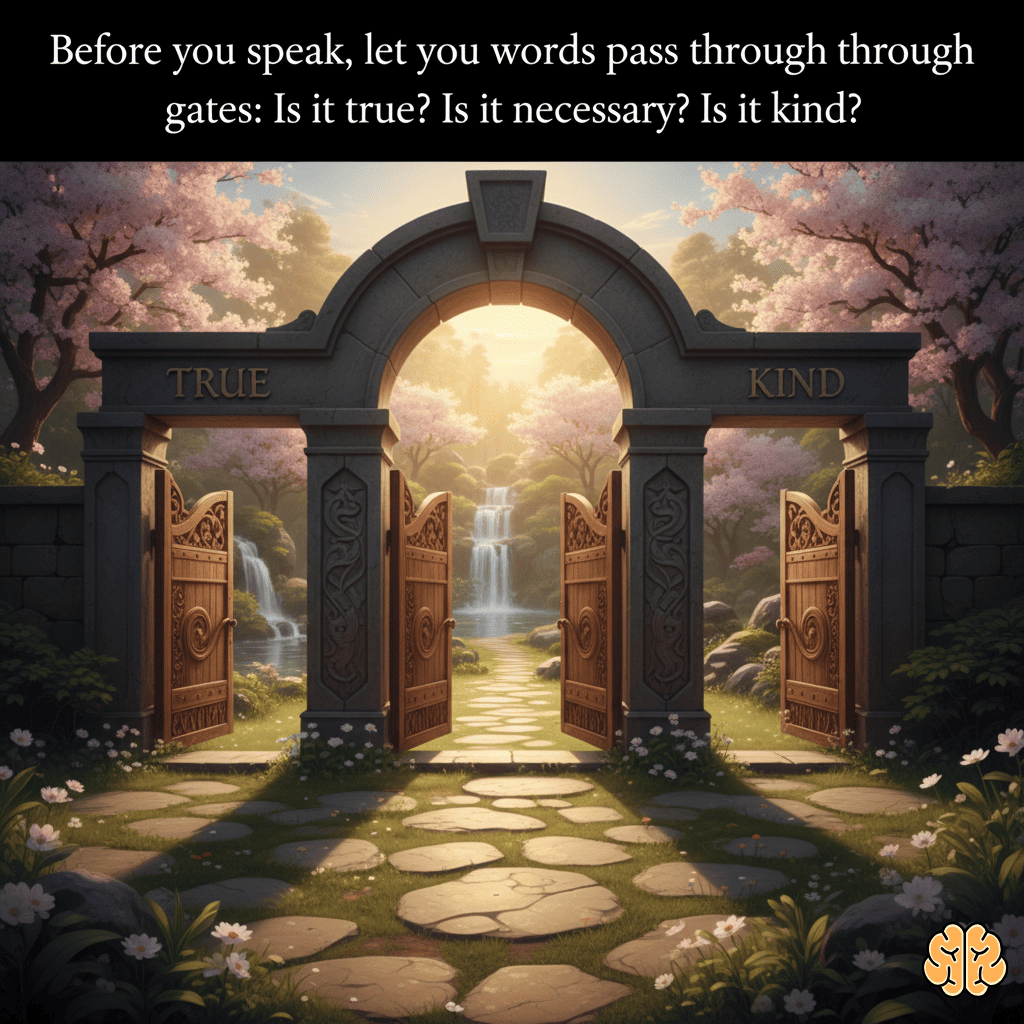
Before you speak, let your words pass through three gates: Is it true? Is it necessary? Is it kind?
By: Often attributed to Buddha or Sufi wisdom, exact origin uncertain | Published on Dec 29,2025
Category Spiritual Quotes
About This Quote
This beautiful teaching about mindful speech appears in various forms across spiritual traditions—Buddhist, Sufi, Christian, and others. While often attributed to Buddha, there's no definitive source in early Buddhist texts. Some trace it to Sufi teachings, others to ancient Greek philosophy (Socrates had a similar "triple filter test"). Regardless of its precise origin, this wisdom has endured across cultures because it addresses something universally challenging: the power and responsibility of our words. It offers a simple yet profound practice for transforming how we communicate.
Why It Resonates
Think about the damage you've caused with careless words. The relationships you've wounded with harsh truths spoken unkindly. The gossip you've spread that wasn't necessary. The lies you've told to protect yourself or manipulate situations. The words you wish you could take back but can't.
And think about the damage done to you by others' words. The criticism that still echoes in your mind years later. The lies that broke your trust. The unnecessary harshness that wounded your spirit. The truth spoken without kindness that cut you deeper than any deception.
Words are powerful. They create and destroy. They heal and wound. They connect and divide. You know this from experience—both as speaker and receiver of words.
Yet how often do you speak without thinking? How often do words tumble out driven by anger, ego, fear, the need to be right, the urge to hurt someone who hurt you? How often do you say things that are true but unnecessary? Necessary but unkind? Kind but untrue?
This three-gate teaching offers a radically simple practice: before you speak, pause. Ask three questions. Let your words pass through three filters. Is it true? Is it necessary? Is it kind?
If your words can't pass through all three gates, maybe they shouldn't be spoken. Maybe silence would be wiser. Maybe you need to find different words. Maybe this isn't the right time, the right place, or the right way.
The Neuroscience Behind It
From a neurological perspective, this teaching is about creating space between impulse and action. Your brain's emotional centers (amygdala and limbic system) generate quick reactions—anger, fear, defensiveness. These systems evolved for survival and operate much faster than your prefrontal cortex, which handles reasoning and ethical judgment.
When you speak impulsively—especially when emotional—you're bypassing the prefrontal cortex and letting the reactive brain drive your words. That's why you say things you later regret. Your thinking brain hadn't caught up to your emotional brain.
The three-gate practice creates a pause. That pause—even just a few seconds—allows your prefrontal cortex to come online. It shifts you from reactive mode to responsive mode. From unconscious to conscious. From autopilot to intentional.
Research on mindfulness and emotional regulation shows that practices which create space between stimulus and response literally strengthen the neural pathways between your prefrontal cortex and limbic system. Over time, this pause becomes more natural. You develop the capacity to feel anger without immediately speaking from it, to notice the urge to gossip without acting on it, to recognize when you're about to speak from ego rather than truth.
There's also fascinating research on the neurological impact of receiving kind versus harsh words. Kind words activate reward centers in the brain and create feelings of safety and connection. Harsh words, even when true, activate threat centers and can cause actual neurological stress responses similar to physical pain.
The teaching isn't just morally wise—it's neurologically sound. Kind words literally create different brain states in both speaker and receiver than harsh ones do.
The Deeper Meaning
This isn't just about being nice or avoiding conflict. The deeper spiritual teaching is about aligning your speech with truth, wisdom, and compassion—the three fundamental spiritual values represented by the three gates.
Is it true? This gate guards against deception, manipulation, and lies—including the lies you tell yourself that you then speak to others. It requires you to examine: Am I speaking from truth or from ego? From reality or from my distorted perception? From honesty or from the desire to protect myself or hurt someone else?
Is it necessary? This gate guards against gossip, unnecessary criticism, and the compulsive need to fill every silence with words. It asks: Does this need to be said? Does it need to be said by me? Does it need to be said right now? Or am I speaking from anxiety, boredom, the need for attention, or the urge to feel superior by talking about others?
Is it kind? This gate guards against cruelty masquerading as honesty. It recognizes that truth can be spoken in ways that heal or ways that harm. It asks: Am I speaking this truth to help or to hurt? Am I choosing words that honor the other person's dignity? Am I speaking from compassion or from anger?
The spiritual maturity is in holding all three together. Not just truth without kindness (which is brutality). Not just kindness without truth (which is enabling). Not just necessity without kindness or truth (which is manipulation).
All three gates. All three values. Truth AND necessity AND kindness.
This is the path of sacred speech—words that serve rather than harm, that heal rather than wound, that connect rather than divide.
Living This Truth
Before you speak—especially when emotional, when tempted to gossip, when about to criticize, when angry—pause. Just pause. Take a breath. This one simple practice changes everything.
In that pause, ask: Is it true? Really examine this. Are you speaking from actual truth or from your interpretation, your assumption, your projection? If you're angry, your "truth" might be distorted by emotion. If you're hurt, your "truth" might be defensive. Get honest about whether what you're about to say is objectively true or just your current feeling.
Then ask: Is it necessary? Does this actually need to be communicated? Will saying this help anyone? Or are you speaking from anxiety, ego, the need to be right, the urge to vent? Sometimes the most necessary thing is silence.
Finally ask: Is it kind? Can you speak this truth in a way that honors the other person? Can you be honest without being cruel? Can you be direct without being harsh? If you can't find a kind way to speak a necessary truth, maybe you need to wait until you can.
And here's the advanced practice: apply these three gates to your internal speech too—the words you say to yourself. Is your self-talk true? Necessary? Kind? Or are you speaking to yourself in ways you'd never accept from anyone else?
Your Reflection Today
What words have you spoken recently that didn't pass through all three gates? What was the impact?
What do you need to say right now—to someone else or to yourself—that you need to filter through these three gates first?
Where do you struggle most: with truth (tendency to lie or exaggerate), with necessity (tendency to gossip or over-share), or with kindness (tendency toward harshness or cruelty)?
Here's what this ancient wisdom wants you to understand: Your words have power. Tremendous power. To build up or tear down. To heal or wound. To connect or divide. To speak truth or spread lies. To create peace or generate conflict.
And with that power comes responsibility. The responsibility to use your words wisely. To speak with intention rather than impulse. To let your speech be guided by truth, necessity, and kindness rather than by ego, anger, or carelessness.
Before you speak today, pause. Let your words pass through the three gates.
Is it true? Not just your interpretation or feeling, but actual truth?
Is it necessary? Does it truly need to be said, by you, right now?
Is it kind? Are you speaking in a way that honors both truth and compassion?
If your words can pass through all three gates, speak them with confidence. They're worth saying.
If they can't pass through all three, maybe silence is the wiser choice. Maybe you need to find different words. Maybe this isn't the right moment.
Your words matter. Let them be true. Let them be necessary. Let them be kind.
Let your speech be sacred—guided by wisdom, spoken with love, serving the highest good.
Three simple gates. Three profound questions. A lifetime of practice.
But practice worth doing. Because the world has enough careless words, enough unnecessary harshness, enough unkind truths.
What the world needs is your voice—when it's true, when it's necessary, and when it's kind.
Let that be your practice today.
Amazon Affiliate Disclosure
As an Amazon Associate I earn from qualifying purchases.
Comments
No comment yet. Be the first to comment