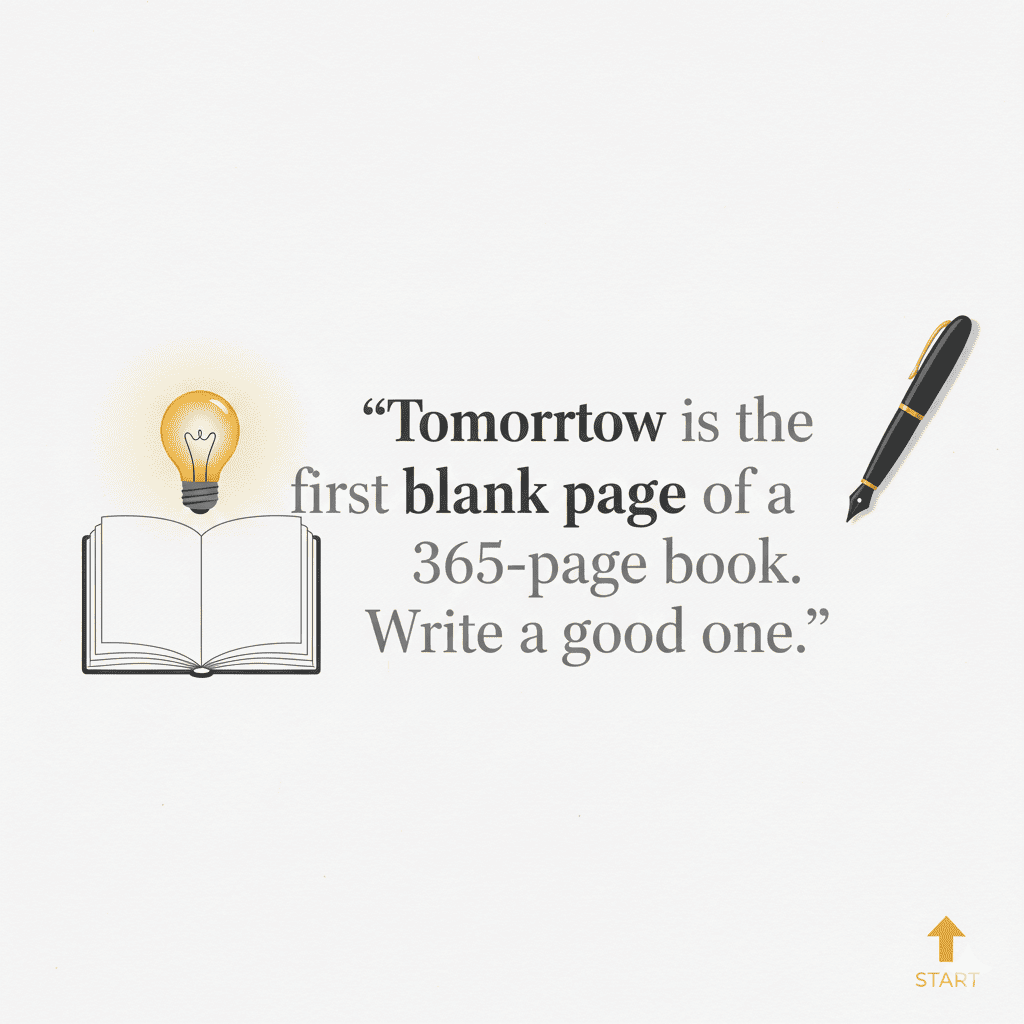
Tomorrow is the first blank page of a 365-page book. Write a good one
By: Brad Paisley | Published on Jan 01,2026
Category Quote of the Day
About This Quote
This hopeful reflection comes from Brad Paisley, a Grammy-winning country music artist known for writing songs that blend humor, heart, and genuine life wisdom. While Paisley is primarily known for his music rather than motivational speaking, this quote has resonated far beyond country music circles, becoming a popular New Year's sentiment shared across social media, greeting cards, and motivational spaces. It captures the unique opportunity that New Year's Day represents—a fresh start, a clean slate, a chance to write your story differently. The metaphor of a blank book is both simple and profound, transforming the abstract concept of "a new year" into something tangible: pages waiting to be filled with your choices, your experiences, your story.
Why It Resonates
Think about how you feel on December 31st. You're looking back at the year that's ending—the successes and failures, the joy and pain, the things you accomplished and the things you didn't. Maybe you're proud of some chapters. Maybe you're embarrassed by others. Maybe there are pages you wish you could tear out and rewrite.
And then midnight hits. January 1st arrives. And something shifts. It's arbitrary, really—just another day on the calendar, another rotation of the Earth. But it doesn't feel arbitrary. It feels significant. It feels like a line has been drawn between what was and what could be.
That's the power of this quote: it acknowledges that tomorrow isn't just another day. It's the first page of a completely new book. Not a continuation of last year's story. Not an extension of your old patterns. A new book. 365 blank pages waiting for you to write them.
Here's what hits hard: you're the author. Not your circumstances. Not other people. Not your past. You. You get to decide what goes on these pages. You get to choose whether this book will be a tragedy or a triumph, a complaint or a celebration, a story of limitation or a story of transformation.
But here's the catch that most people miss when they get excited about New Year's resolutions: you don't write a good book by making grand declarations on page one. You write a good book one page at a time, one day at a time, one choice at a time. The question isn't "What amazing transformation will happen this year?" The question is "What will I write on page one? On page two? On today's page?"
The Psychology Behind It
There's fascinating research on what psychologists call "temporal landmarks"—specific dates that feel psychologically significant (birthdays, anniversaries, New Year's Day). Studies show that these landmarks create what's called "the fresh start effect."
Research by Katy Milkman and colleagues at the University of Pennsylvania found that people are significantly more likely to pursue aspirational behaviors (starting a diet, joining a gym, committing to a goal) following temporal landmarks. Why? Because these moments help us mentally separate our past self from our future self. They create a psychological clean slate.
The New Year is the ultimate temporal landmark. It's not just another Monday or the first of the month—it's January 1st, the beginning of an entire year. Your brain treats this as an opportunity to close the book on your old story and start a new chapter (or in this case, a new book).
But here's what's crucial about the research: the fresh start effect is powerful for initiation but not necessarily for maintenance. People start strong on January 1st but often abandon their resolutions by February. Why? Because they're focused on writing an amazing book (the grand outcome) rather than writing one good page at a time (the daily process).
Neuroscience research on habit formation shows that sustainable change comes from small, consistent actions repeated over time. Your brain builds new neural pathways through repetition, not through dramatic one-time efforts. You don't write a good 365-page book by writing an amazing first page and then coasting. You write it by showing up to write page after page after page.
There's also research on "narrative identity"—the stories we tell ourselves about who we are. When you think of the New Year as a blank book, you're giving yourself permission to change your narrative. You're not locked into last year's story. You can become the protagonist of a different kind of story starting now.
The Deeper Meaning
This quote isn't just about New Year's resolutions or goal-setting. It's about authorship and agency. It's about recognizing that you have creative power over your own life story.
Think about the metaphor: a 365-page book. That's specific. That's finite. You don't have infinite pages. You have 365. That's it. When December 31st arrives, this book is done. The pages are filled—with whatever you chose to write on them.
This creates both urgency and opportunity. Urgency because time is limited. You can't waste pages on stories that don't matter, on chapters you'll regret, on narratives that diminish you. Every day is a page, and you only get 365 of them this year.
But also opportunity, because even if you write a terrible page one, you still have 364 pages left. If January is a disaster, you still have February through December to turn the story around. One bad chapter doesn't ruin the whole book. One good page can redirect the entire narrative.
The deeper wisdom is about daily authorship. You are writing your story whether you realize it or not. Every choice is a sentence. Every action is a paragraph. Every day is a page. The question isn't whether you'll write—you will, just by living. The question is: will you write consciously or unconsciously? Intentionally or accidentally? As the author or as someone who lets circumstances write for you?
"Write a good one" isn't about writing a perfect one. It's about writing authentically, purposefully, courageously. It's about making your book worth reading when you look back—not because everything went right, but because you showed up as the author of your own story.
Living This Truth
On January 1st, don't just make resolutions. Ask yourself: "If this year were a book, what story do I want to tell? What kind of protagonist do I want to be? What themes do I want running through the chapters?"
Get specific about your narrative. Is this the year your book is about healing? About building? About letting go? About taking risks? About deepening relationships? About discovering yourself? Choose your central theme. Let it guide your daily choices.
But then—and this is crucial—shift from thinking about the whole book to writing today's page. What goes on page one? What choices, actions, thoughts, and experiences do you want to fill January 1st with? Don't overwhelm yourself with writing all 365 pages perfectly. Just write one good page today.
Develop a daily practice of conscious authorship. Each evening, reflect: "What did I write on today's page? Am I proud of it? Does it align with the story I want to tell?" Each morning, ask: "What will I write on today's page? What one sentence, one action, one choice will make this page worth including in my story?"
And here's important: when you write a bad page—and you will—don't throw out the whole book. Don't conclude "I've ruined it, might as well give up." No good book is all great pages. There are boring pages, difficult pages, pages where the protagonist struggles or fails. That's part of a real story. Just commit to making the next page better.
Keep your book alive all year. New Year's Day isn't the only blank page—every day is. January 1st gives you 365 blank pages, but you fill them one at a time. Don't let the fresh start effect fade by February. Recommit to conscious authorship daily.
Your Reflection Today
If your life this year were a book that others would read, what story would you want to tell? What themes would run through it?
What kind of protagonist do you want to be in this year's story? Brave? Kind? Honest? Growing? Healing? Building? Adventurous?
What will you write on page one—on January 1st? What specific choices and actions will fill that first page?
Here's what this quote wants you to understand: Tomorrow is different. Not because the calendar says so. Not because of magic or cosmic significance. But because you're choosing to make it different.
You're holding 365 blank pages. That's your year. That's your opportunity. That's your canvas, your chance, your fresh start.
You can write a good one. You can write a story you're proud of. You can write chapters of growth, resilience, love, courage, and transformation. You can become the protagonist of a story worth telling.
But you have to actually write it. You have to show up every day and put something on the page. You have to make choices that align with the story you want to tell. You have to be intentional about what you're authoring.
Last year's book is closed. You can't edit those pages. You can't rewrite those chapters. That book is done, finished, on the shelf. Learn from it, yes. But don't stay stuck trying to revise what's already written.
This year? This year is a blank book. 365 empty pages waiting for your story.
What will you write?
Will you write the same story you've been writing for years? The same patterns, the same complaints, the same limitations, the same excuses?
Or will you write something new? Something brave? Something true? Something that, when you read it on December 31st, makes you say "I'm proud of this. This was a life well-lived. This was a story worth writing."
You're the author. You hold the pen. The pages are blank.
Tomorrow is page one.
Write a good one.
Not a perfect one. Not a flawless one. Just a real one. An honest one. An intentional one. A page that starts the kind of story you actually want to live.
365 pages. One year. Your story.
Make it count.
Happy New Year.
Now go write something beautiful.
Amazon Affiliate Disclosure
As an Amazon Associate I earn from qualifying purchases.
Comments
No comment yet. Be the first to comment