
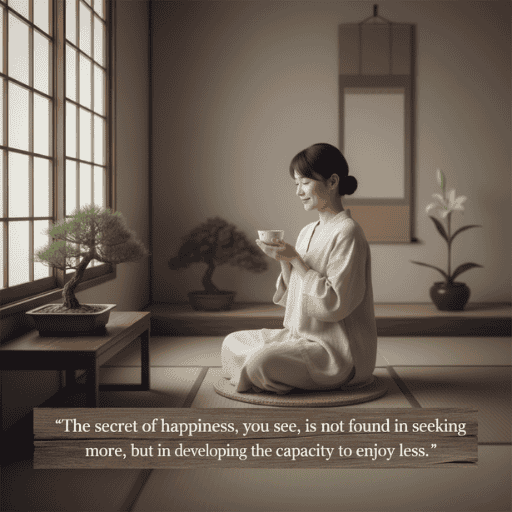
The secret of happiness, you see, is not found in seeking more, but in developing the capacity to enjoy less
By: Socrates | Published on Feb 02,2026
Category Spiritual Quotes
About This Quote
This profound wisdom is attributed to the ancient Greek philosopher Socrates (469-399 BCE), who lived a life of radical simplicity in Athens while teaching the most influential philosophical ideas in Western civilization. While the exact wording may not appear in surviving Socratic dialogues, the sentiment perfectly captures his philosophy of life. Socrates famously walked through the Athenian marketplace saying "How many things I can do without!"—marveling not at what he wanted to buy, but at how little he actually needed.
Socrates owned almost nothing, wore the same simple clothes, ate basic food, and yet was described as one of the happiest men in Athens. He understood what modern consumer culture tries desperately to hide from you: happiness isn't found in accumulation. It's found in the freedom that comes from needing less. This quote captures that revolutionary insight—the path to contentment isn't getting more of what you want, but wanting less of what you don't need.
Why It Resonates
Think about your life right now. How much of what you think you "need" is actually just want disguised as need? You need a phone—but do you need the latest model? You need clothes—but do you need that specific brand? You need food—but do you need to eat out five times a week? You need shelter—but do you need a bigger house?
Your mind is constantly upgrading wants into needs. That new gadget? Your mind tells you you need it. That upgrade? Your mind says it's essential. That purchase? Your mind convinces you it's necessary. And before you know it, you're trapped in an endless cycle of chasing things your mind has convinced you that you need, even though you were fine without them yesterday.
This is your mind controlling you. Your mind sees an advertisement and creates a need. Your mind sees what someone else has and creates a feeling of lack. Your mind compares your life to others' and generates dissatisfaction with what you have. Your mind is constantly manufacturing needs that didn't exist five minutes ago.
And here's what's insidious about it: each time you give in to these manufactured needs, you strengthen the pattern. You teach your mind that creating false needs works. That generating dissatisfaction gets rewarded with a purchase. That feeling lack leads to temporary relief through acquisition. You're training yourself to be perpetually unsatisfied, perpetually needing more.
But Socrates understood the reverse is also true: you can develop the capacity to enjoy less. You can train your mind to find satisfaction in simplicity. You can cultivate contentment with what you already have. You can break free from the endless treadmill of wanting more.
The happiness you're chasing through acquisition? It's not in the thing you're buying. It's in the state of mind that needs less. It's in the freedom that comes from looking at something and genuinely feeling "I don't need that." It's in the peace of being content with what you have instead of constantly reaching for what you don't.
The Psychology Behind It
Modern psychology has extensively studied what's called the "hedonic treadmill" or "hedonic adaptation." Research shows that when you acquire something you wanted, you experience a brief spike in happiness—but you quickly adapt to the new normal and return to your baseline happiness level. Then you need something else to get that spike again. It's an endless cycle that never leads to lasting satisfaction.
Studies on materialism and wellbeing consistently show an inverse relationship: the more you focus on material possessions and external acquisitions, the lower your life satisfaction, the higher your anxiety and depression, and the worse your relationships. Chasing more doesn't make you happier—it makes you less happy.
There's fascinating research on "decision fatigue" showing that having too many options actually decreases satisfaction. The paradox of choice: when you have unlimited options and unlimited wants, you're overwhelmed and never fully satisfied with what you choose because you're always wondering if something else would have been better.
But studies on minimalism and voluntary simplicity show the opposite effect: people who deliberately reduce their possessions and focus on needs rather than wants report higher life satisfaction, less stress, more free time, better relationships, and greater overall wellbeing. Developing the capacity to enjoy less doesn't deprive you—it liberates you.
Neuroscience research on desire and satisfaction reveals that the anticipation of getting something activates your brain's reward centers more than actually having it. Your brain is literally designed to enjoy wanting more than having. This is why getting the thing never satisfies as much as you expect—your brain was more excited about the chase than the catch.
Research on advertising and consumer behavior shows that you're exposed to thousands of advertisements daily, each one designed to create dissatisfaction with what you have and desire for what you don't. Your mind is being constantly manipulated to generate false needs. Awareness of this manipulation is the first step to freedom from it.
The Deeper Meaning
This quote is really about freedom and control. When you need more to be happy, you're enslaved to those needs. You're dependent on external circumstances, market forces, other people's production, your own ability to acquire. You're constantly vulnerable because your happiness depends on getting things outside yourself.
But when you develop the capacity to enjoy less—when you genuinely need less to be content—you're free. Free from debt. Free from the pressure to earn more. Free from envy of what others have. Free from the anxiety of losing what you have. Free from the endless treadmill of acquisition.
"Developing the capacity" is crucial. This isn't about deprivation or forcing yourself to live without things you actually need. It's about training your mind to distinguish genuine needs from manufactured wants. It's about cultivating appreciation for what you have. It's about finding satisfaction in simplicity rather than constantly seeking it in acquisition.
The deeper wisdom is that happiness is a skill, not a circumstance. You think happiness comes from getting what you want. But Socrates is teaching that happiness comes from wanting what you have. From finding joy in simplicity. From being content with enough. That's a capacity you develop through practice, not something you acquire through purchase.
This quote also challenges the fundamental premise of consumer culture: that more is better, that growth is always good, that satisfaction comes from expansion. Socrates is saying: less can be better, restraint can be good, satisfaction comes from contraction of needs.
The deepest truth: your mind will create endless needs if you let it. There's no final purchase that will satisfy it. There's no level of accumulation that will make it stop wanting more. The only way to find contentment is to stop feeding the cycle. To develop the capacity to be happy with less instead of always chasing more.
Living This Truth
Practice the "need vs want" distinction daily. Before any purchase, ask: "Is this actually a need, or is my mind upgrading a want into a need?" Get honest with yourself. Most of what you buy are wants pretending to be needs. Recognizing this doesn't mean you never buy things you want—it means you stop lying to yourself about what's actually necessary.
Do the "do without" experiment. Intentionally go without something you think you need and discover you're fine. Don't upgrade your phone when the new model comes out. Skip the purchase you were planning. Eat simple meals instead of eating out. You'll discover that most of what your mind tells you that you need, you actually don't. This builds the capacity to enjoy less.
Practice gratitude for what you have. Your mind's default is to focus on what you lack. Actively counter this by regularly appreciating what you already have. Not in a "I should be grateful" obligatory way, but in genuine recognition that what you have is enough. This trains your mind toward contentment instead of lack.
Identify and eliminate triggers for false needs. Unsubscribe from marketing emails. Unfollow social media accounts that make you feel inadequate. Stop window shopping. Reduce exposure to advertising. Your mind is being deliberately manipulated to create dissatisfaction—remove yourself from that manipulation.
Simplify deliberately. Not as punishment or deprivation, but as an experiment in freedom. Reduce possessions. Simplify routines. Minimize options. Notice how this creates space, reduces stress, and paradoxically increases satisfaction. Less to maintain. Less to worry about. Less to want. More peace.
And most importantly: celebrate victories over your mind's false needs. When you want something but recognize you don't actually need it and choose not to buy it—that's a win. That's you developing the capacity Socrates describes. Each time you do this, you're training your mind toward contentment instead of constant wanting.
Your Reflection Today
What are you currently convinced you "need" that's actually just a want your mind has upgraded?
What would change in your life if you developed the capacity to be content with what you already have instead of constantly seeking more?
What's one area where you could practice enjoying less—not as deprivation but as freedom from false needs?
Here's what Socrates wants you to understand: You're looking for happiness in the wrong place. You think it's in the next purchase, the next upgrade, the next acquisition. You think if you just get enough stuff, achieve enough status, acquire enough possessions, you'll finally be satisfied.
But you won't. You never will be. Because the problem isn't that you don't have enough. The problem is that your mind has an unlimited capacity to generate new needs. Get the thing, and your mind immediately identifies the next thing. Achieve the goal, and your mind sets a higher goal. Acquire the possession, and your mind wants something better.
This isn't because you're broken or greedy. This is how minds work when they're not trained otherwise. Your mind is designed to seek, to want, to desire more. That's not the problem—that's just the default setting. The problem is that you've mistaken these mental impulses for actual needs. You've let your mind convince you that its wants are necessities.
But they're not. Most of what you think you need, you don't. Most of what you're chasing, you'd be fine without. Most of what you're convinced is essential to your happiness is just your mind creating another false need.
The secret of happiness isn't getting all those things your mind tells you that you need. The secret is developing the capacity to be happy without them. To look at something you want and genuinely feel "that's nice, but I don't need it." To find satisfaction in simplicity instead of constantly seeking it in acquisition.
This isn't about becoming a monk or living in poverty. This is about freedom. Freedom from the endless treadmill of wanting more. Freedom from debt incurred to buy things you don't need. Freedom from working jobs you hate to afford lifestyles you can't sustain. Freedom from the anxiety of never having enough.
You have enough. Right now. You're enough. What you have is enough. The problem isn't that you lack what you need. The problem is that your mind keeps creating new needs.
So stop feeding that pattern. Stop upgrading wants into needs. Stop believing every desire is a necessity. Stop chasing happiness through acquisition.
Instead, develop the capacity to enjoy less. To be content with what you have. To find joy in simplicity. To need less instead of always wanting more.
That's where happiness lives. Not in the next purchase. Not in having more. In needing less.
Control your mind before it controls you. Distinguish real needs from manufactured wants. Develop the capacity to be satisfied with enough.
Because enough is enough. And you already have it.
Stop seeking more. Start enjoying less.
That's the secret. 🌿✨
Amazon Affiliate Disclosure
As an Amazon Associate I earn from qualifying purchases.
Comments
No comment yet. Be the first to comment