
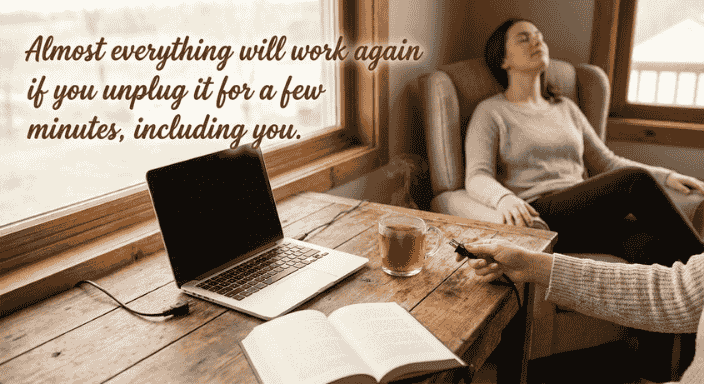
Almost everything will work again if you unplug it for a few minutes, including you.
By: Anne Lamott | Published on Feb 09,2026
Category Spiritual Quotes
About This Quote
This brilliantly simple wisdom comes from Anne Lamott, the acclaimed American novelist and non-fiction writer known for her honest, raw, and often humorous takes on life, faith, and the human condition. Lamott has written extensively about her struggles with addiction, perfectionism, and the relentless pace of modern life. This quote appears in her writings about self-care, recovery, and the radical act of stopping.
Lamott speaks from hard-won experience. She's lived through burnout, breakdown, and the consequences of never stopping. She understands that our culture treats "busy" as a badge of honor and "rest" as laziness. This quote is her gentle rebellion against that toxic narrative. It's tech support advice for your life: when things aren't working, the solution isn't to keep pushing harder—it's to unplug, reset, and start fresh.
Why It Resonates
Think about what you do when your phone freezes or your computer starts glitching. You don't keep frantically pressing buttons, making it worse. You don't panic and throw it away. You do something simple and obvious: you turn it off, wait a moment, then turn it back on. You unplug it. You let it reset. And usually, that fixes it.
But when you start glitching—when you're stressed, overwhelmed, making mistakes, feeling scattered—what do you do? You keep pushing. You work harder. You add more to your schedule. You consume more caffeine. You try to power through. You do everything except the one thing that actually works: unplug.
You're moving so fast that you can't see where you actually are. You're so focused on the next thing, the next deadline, the next obligation that you've lost all awareness of this moment, this place, this reality. You're physically here, but mentally you're everywhere else—rehashing the past, planning the future, worrying about what's next.
And in that constant motion, you lose yourself. You lose clarity. You lose effectiveness. You lose joy. You're running so fast that everything becomes a blur. You can't see the details of your life. You can't appreciate what you have. You can't even assess accurately what's working and what isn't because you never stop moving long enough to look.
This quote is permission—permission to stop. Permission to unplug. Permission to reset. Not as failure or weakness, but as essential maintenance. You are not a machine that can run indefinitely. You are a human being who needs to pause, rest, and recalibrate.
The Science Behind It
There's extensive research on what psychologists call "cognitive restoration"—the brain's need for recovery from sustained attention and mental effort. Studies show that continuous mental activity without breaks leads to decreased performance, increased errors, reduced creativity, and impaired decision-making. Your brain literally needs to unplug to function optimally.
Research on attention and productivity reveals something counterintuitive: taking breaks actually increases overall productivity. The Pomodoro Technique, time-blocking methods, and other productivity systems all incorporate regular pauses because continuous work produces diminishing returns. Your best work comes not from working longer, but from working with rhythm—periods of focus followed by periods of rest.
Neuroscience shows that different brain states serve different functions. The task-positive network (active when you're focused on external tasks) needs to alternate with the default mode network (active during rest, daydreaming, reflection). Both are necessary for optimal functioning. When you never unplug, you're stuck in task-positive mode, which prevents the creative insights, self-awareness, and mental integration that happen in default mode.
There's fascinating research on "decision fatigue"—the deteriorating quality of decisions after a long session of decision-making. Judges grant parole more often at the beginning of the day and after breaks than at the end of long sessions. Your judgment improves after rest, not from pushing through exhaustion.
Studies on mindfulness and present-moment awareness show that people who regularly practice being "here now" instead of constantly racing ahead experience lower stress, better emotional regulation, improved relationships, and greater life satisfaction. Slowing down enough to see where you are isn't indulgent—it's essential for wellbeing.
Research on burnout demonstrates that it's not primarily caused by hard work—it's caused by continuous work without recovery. Athletes understand this: rest days are when muscles actually grow stronger. Your mind works the same way. Unplugging isn't the opposite of productivity—it's a necessary component of sustainable high performance.
The Deeper Meaning
This quote is really about presence and perspective. When you're constantly plugged in—to work, to obligations, to the relentless pace of life—you lose the ability to see clearly. You're so close to everything, moving so fast through everything, that you can't actually perceive what's happening.
"Almost everything will work again" acknowledges that most of what feels broken isn't actually broken—it's just overloaded. You're not failing. You're not inadequate. You're not broken. You're just running too hot for too long without rest. The solution isn't to try harder—it's to stop, cool down, reset.
The comparison to unplugging devices is perfect because it reveals how differently we treat technology versus ourselves. We understand that devices need to reset. We don't judge our phone for needing to restart. We don't call our computer weak for freezing under too much load. We simply recognize: "This needs to stop and restart to work properly again."
But with ourselves? We judge. We push. We shame ourselves for needing rest. We treat our need to unplug as weakness rather than basic functionality.
The deeper wisdom is that you cannot see where you are while you're racing through it. You cannot gain perspective while you're buried in it. You cannot course-correct when you never pause to check your direction. Unplugging isn't about escape—it's about reality. It's the only way to actually see what's true instead of just reacting to what's immediate.
And "including you" is the crucial part. This isn't just about devices. This is about you. Your mind. Your body. Your spirit. Your life. You need to unplug. You need to reset. You need to slow down enough to see where you actually are instead of just blindly racing to wherever you think you should be.
Living This Truth
Schedule unplugging time. Not "if you have time," not "when things calm down." Now. Regularly. Non-negotiably. Daily micro-breaks. Weekly longer breaks. Monthly mini-resets. You schedule meetings, appointments, obligations—schedule unplugging with the same seriousness.
Practice the "where am I?" check. Several times a day, stop. Literally stop moving. Ask yourself: "Where am I right now? Not where should I be, where do I need to be, where am I going—where am I right now?" Look around. Actually see your environment. Notice your body. Feel your breath. Be here.
Unplug from all devices for at least one hour daily. Not just put them down while you do other tasks—actually turn them off and be completely unplugged. Notice how your mind responds. Notice the anxiety, the compulsion to check, the discomfort of true quiet. Sit with it. That discomfort is showing you how plugged in you've become.
Create a physical "unplug" ritual. A specific chair where you sit and do nothing. A walk you take without phone or agenda. A practice (meditation, journaling, sitting in nature) that signals to your brain: "We're unplugging now." Make it sacred. Make it non-negotiable.
Notice what "works again" after unplugging. Problems that seemed impossible? Often they're clearer after rest. Creativity that was stuck? It flows after unplugging. Relationships that felt strained? They improve when you're actually present. Energy that was depleted? It returns when you stop draining it.
And slow down enough to actually see your life. You're living days, weeks, months that you're not even conscious of because you're moving too fast to perceive them. Your life is happening right now. Can you see it? Or are you too plugged in, too busy, too focused on the next thing to notice this thing?
Your Reflection Today
When was the last time you truly unplugged—not just physically stopped, but mentally disconnected from all obligations, screens, and the relentless pace?
What in your life right now feels "broken" or "not working" that might actually just need you to unplug and reset?
If you slowed down enough to truly see where you are right now—this moment, this life, this reality—what would you notice that you've been too busy to see?
Here's what Anne Lamott wants you to understand: You are glitching. Right now. You might not realize it because you've been glitching for so long it feels normal. But the stress, the overwhelm, the constant sense of not-quite-functioning-optimally—that's you operating while overloaded.
And you're trying to fix it the wrong way. You're trying to run faster, work harder, push through, optimize, add more productivity hacks, consume more caffeine, squeeze more hours out of the day.
But that's like trying to fix a frozen computer by clicking more buttons. It doesn't help. It makes it worse. The computer doesn't need more input—it needs to reset.
You don't need more productivity. You need to unplug.
You don't need better time management. You need to stop managing time for a moment and just be in time.
You don't need to optimize your performance. You need to interrupt your performance and rest.
Almost everything will work again if you unplug it for a few minutes. Including you.
That problem you're ruminating about? Unplug from it for an hour. Come back with fresh perspective. That decision you can't make? Unplug from analyzing it. Let your unconscious mind process. That creative block? Unplug from forcing it. Let inspiration return naturally.
You are so plugged in—to work, to your phone, to obligations, to the constant stream of information and demands—that you've forgotten what it feels like to be unplugged. You've forgotten what clarity feels like. You've forgotten what presence feels like. You've forgotten what it's like to actually see where you are instead of just racing through it.
And you can't fix that by working harder. You can only fix it by stopping. By unplugging. By giving yourself the reset that every functioning system requires.
So today—right now—unplug. Not for long. Just for a few minutes. Turn off your devices. Close your laptop. Put down your phone. Stop working. Stop planning. Stop scrolling. Stop consuming information.
Just stop.
Sit. Breathe. Look around. Where are you? What do you see when you actually look instead of just glancing while rushing past? What do you feel when you're not distracted by screens and tasks?
This is your life. Right here. Right now. But you've been too plugged in to see it.
Unplug. Even just for a few minutes.
Let yourself reset. Let your mind rest. Let your perspective return.
Almost everything will work again. Including you.
You just need to unplug first. 🔌✨
Amazon Affiliate Disclosure
As an Amazon Associate I earn from qualifying purchases.
Comments
No comment yet. Be the first to comment