
The Story of Damon and Pythias
By: Compiled from various sources | Published on Feb 12,2026
Category Moral Stories
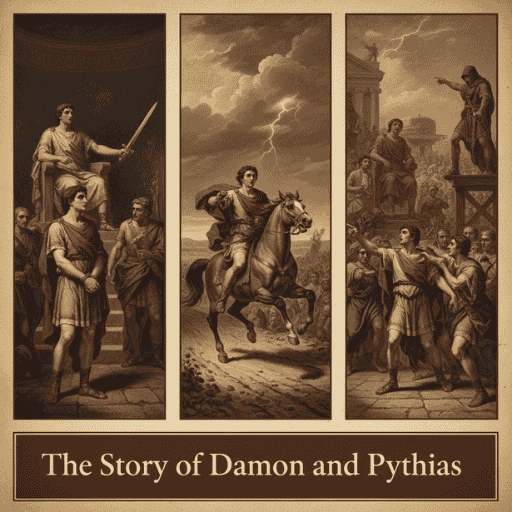
In ancient Syracuse, a young man named Pythias was sentenced to death by the tyrant king Dionysius for speaking against his rule. Pythias accepted his sentence but begged the king for one final request: to return to his hometown to say goodbye to his family and settle his affairs.
The king laughed. "Why would I release a condemned man? You'll never return."
But Pythias had a friend named Damon who stepped forward without hesitation. "Your Majesty," Damon said calmly, "I will take his place. If Pythias does not return by the appointed day, execute me in his place."
The king was stunned—but agreed. Pythias was freed, and Damon was imprisoned.
Days passed. Then weeks. The execution date approached. Pythias had not returned. The king visited Damon in prison, certain he had been abandoned, expecting to see a man broken by fear and betrayal.
But Damon sat calmly. "He will come," he said simply. "Pythias will not abandon me."
On the morning of the execution, with the executioner ready and the crowd assembled, there was still no sign of Pythias. Damon was led to the execution ground. He did not beg. He did not curse his friend. He stood quietly, trusting completely.
Then, at the last possible moment, a figure came racing through the crowd—breathless, dust-covered, exhausted. Pythias had faced floods, bandits, and every obstacle imaginable on his journey back. He pushed through to Damon and embraced him.
"I'm here," he said. "I'm here."
King Dionysius stood in stunned silence for a long moment. Then, for the first time in his tyrannical reign, he was moved to tears.
"I have always ruled through fear and force," he said quietly. "But I have never seen anything like this. I cannot execute either of you." He freed them both. Then he turned to them and asked the one thing a tyrant had never asked before: "Would you consider me your friend too?"
About This Story
The story of Damon and Pythias is one of the oldest and most enduring tales of friendship in human history, originating in ancient Greece and recorded by multiple writers including Diodorus Siculus in the 1st century BCE. While historical details vary across different tellings—some versions mention Pythias was delayed by storms, others by bandits—the core truth of the story has remained constant for over 2,000 years.
The story was so powerful that it became a classical symbol of true friendship, loyalty, and trust. The names Damon and Pythias became synonymous with faithful friendship across the ancient world. Even the tyrant king—a man who ruled through cruelty and fear—was transformed by witnessing what genuine friendship looks like.
Why This Story Resonates
Think about the friendships in your life. How many of them have been truly tested? How many people in your life would bet their life on your return? How many would you bet your life on?
These are uncomfortable questions because most friendships don't require this level of commitment. We never have to find out if we'd really be there for each other under extreme circumstances. And so we assume—but never truly know—how deep our friendships run.
Damon didn't have to think about it. There was no calculation, no weighing of risks, no hesitation. When his friend's life was on the line, Damon stepped forward immediately. "I will take his place." Not "let me think about it." Not "I'll pray for you." Not "that's terrible, I wish there was something I could do." He acted. Without hesitation. Completely.
And Pythias—facing floods, bandits, exhaustion, and every possible obstacle—didn't give up. He didn't tell himself "Damon will understand if I can't make it back. He knows I tried." He pushed through everything because his friend was waiting. Because Damon had trusted him with his life. And that trust was sacred.
This story resonates because somewhere in your heart, you know this is what real friendship is. Not the easy part—the fun times, the good conversations, the mutual enjoyment. The hard part. The showing up when it costs you something. The trusting completely when there's no guarantee. The racing back through every obstacle because someone you love is counting on you.
The Psychology Behind It
Psychological research on deep friendship reveals that what distinguishes superficial relationships from profound ones is exactly what this story depicts: tested commitment. Studies show that friendships which have survived hardship, sacrifice, and tested loyalty create what psychologists call "strong ties"—connections characterized by deep trust, mutual investment, and genuine commitment.
Research on trust and betrayal shows that Damon's unshakeable faith in Pythias isn't naive—it's the result of knowing someone's character completely. Deep friendships are built on accumulated evidence of character. Damon didn't just hope Pythias would return—he knew Pythias. And knowledge of someone's character is the foundation of genuine trust.
There's fascinating research on what's called "costly signaling" in relationships. Acts that require significant sacrifice—giving up your safety, your resources, your comfort for a friend—are powerful precisely because they're costly. They can't be faked. They can't be performed for image. They reveal true commitment. Damon's willingness to die for Pythias was the ultimate costly signal: proof that this friendship was real.
Studies on social bonds formed through shared adversity show they're among the strongest and most lasting human connections. Soldiers who've fought together, survivors who've endured disaster together, friends who've been through genuine hardship together—these bonds are deeper than anything formed in easy circumstances.
Research on prosocial behavior shows that witnessing extraordinary acts of friendship—like the king witnessing Damon and Pythias—actually transforms observers. Psychologist Jonathan Haidt calls this "elevation"—the warm, inspiring feeling you get from witnessing exceptional moral behavior. The king's transformation wasn't weakness—it was his humanity responding to genuine virtue.
The Deeper Meaning
This story has three layers of meaning about friendship, trust, and human transformation.
The first layer is about trust. Damon's willingness to take Pythias's place was an act of complete trust. He didn't know for certain that Pythias would return. He couldn't control what would happen. He simply trusted—based on his knowledge of his friend's character—that Pythias would do everything in his power to come back. That trust is the foundation of the deepest friendships. Not naive faith, but trust built on knowing someone's character.
The second layer is about commitment. Pythias faced every possible obstacle on his return journey. He could have given up. He could have told himself he tried. But his commitment to his friend—and to honoring the trust Damon had placed in him—drove him through every barrier. Real friendship isn't just feeling—it's commitment that drives action even when action is costly and difficult.
The third and most profound layer is about transformation. The king—a tyrant, a man who ruled through fear and cruelty—was transformed by witnessing authentic friendship. He experienced something he'd never encountered: two people who loved each other more than they feared death. And it changed him. It didn't just move him emotionally—it revealed a possibility he'd never seen. That humans could live by something other than fear and self-interest.
This is the deepest moral: genuine friendship doesn't just affect the friends—it transforms everyone who witnesses it. Your authentic, committed, sacrificial friendship is not just good for you and your friend. It's a gift to the world. It shows everyone around you that this kind of love is possible.
Living This Truth
Examine the depth of your current friendships. Not to judge them, but to understand them. Which friendships are social comfort—enjoyable, pleasant, but untested? Which friendships are genuine—built on mutual knowledge, tested commitment, proven trust?
Be the friend who shows up before being asked. Like Damon, who didn't wait for Pythias to beg for help—he stepped forward immediately. Don't make your friends ask multiple times. Don't wait until they're desperate. Show up before they have to ask. Show up when it costs you something.
Honor commitments to friends even when it's difficult. Pythias faced floods and bandits but didn't give up. When you make a commitment to a friend, honor it even when circumstances make it hard. Especially when circumstances make it hard. That's when it matters most.
Build trust through consistent character. Damon's faith in Pythias was based on knowing his character. Build the kind of character that your friends can stake their lives on. Be the person who keeps promises, who shows up, who comes back, who can be trusted completely.
Let your friendships be transformed by adversity. Don't just maintain friendships in easy times. Lean in when things are hard. Be there in the crises. Show up in the storms. The friendships you build through difficulty are the ones that last and deepen.
And recognize that your friendships affect more than just you and your friend. The king was transformed by witnessing Damon and Pythias. Your friendship—when it's genuine, committed, and loyal—inspires everyone around you. It models what's possible. It elevates everyone who witnesses it.
Your Reflection Today
Who in your life would you take the place for—whose difficulty, whose burden, whose sacrifice would you willingly share?
Who in your life would race back through every obstacle for you—not because they had to, but because you are worth it to them?
What would it look like for you to be the Damon in someone's life this week—to step forward, without being asked, when a friend needs someone?
Here's what this ancient story wants you to understand: Real friendship is not comfortable. Real friendship is not convenient. Real friendship is not just showing up for the easy parts while disappearing when things get hard.
Real friendship is Damon stepping forward when no one asked him to. Real friendship is Pythias racing back through every obstacle because someone trusted him with their life. Real friendship is knowing someone's character so completely that you'd bet your life on it. And proving your character so thoroughly that someone would bet their life on you.
You might be thinking: "That's an ancient story. Nobody faces execution today. How does this apply to my life?"
But the principle is alive in every friendship. When your friend is going through divorce and everyone else gets uncomfortable and disappears—will you be Damon, staying present when others leave? When your friend needs someone to show up at 2 AM because they can't stop crying—will you be Damon, there without hesitation? When you promise to be there for something that matters deeply to your friend, and then circumstances make it difficult—will you be Pythias, racing back through every obstacle to honor your word?
The tyrant king had power, wealth, armies. But he was bankrupt in the one thing that mattered: genuine connection, genuine trust, genuine love. And when he witnessed it—when he finally saw what two people could be to each other—it cracked him open. It awakened something human in him that tyranny had buried.
Your friendship can do that too. Not because you're performing virtue, but because genuine friendship is genuinely rare. Most people live behind walls, performing relationships rather than having them. When they witness something real—someone who shows up fully, trusts completely, sacrifices willingly—it cracks them open.
Be that kind of friend. Find that kind of friend. Treasure that kind of friend.
Because the world has enough surface-level connections.
What it needs—what you need—is someone who knows all about you and still loves you. Someone who would step forward without hesitation. Someone you'd race back through every storm to get to.
Damon and Pythias found that in each other. Two thousand years later, their story is still being told. Because real friendship? It outlasts everything.
Even death. 💙🤝
The Moral
True friendship isn't proven in easy times—it's revealed in hard ones. The depth of your friendship isn't measured by how much you enjoy each other, but by how much you'd sacrifice for each other. A friend who shows up when it costs them something is worth more than a hundred friends who only show up when it's convenient. Be the kind of friend whose character can be trusted completely. Be the Damon. Be the Pythias. And the world around you will be transformed by what they witness.
Amazon Affiliate Disclosure
As an Amazon Associate I earn from qualifying purchases.
Comments
No comment yet. Be the first to comment