
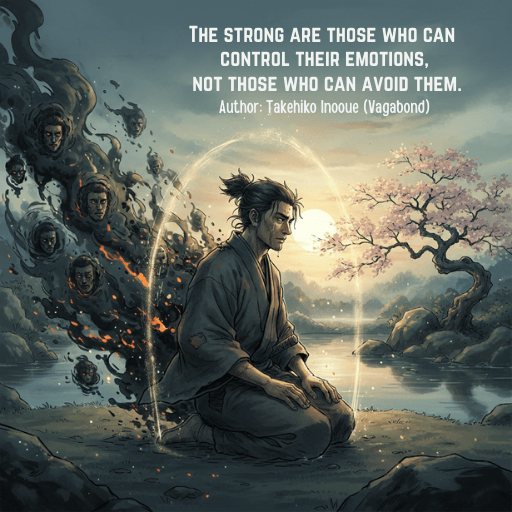
The strong are those who can control their emotions, not those who can avoid them.
By: Takehiko Inoue (Vagabond) | Published on Feb 28,2026
Category Quote of the Day
About This Quote
This profound wisdom comes from "Vagabond," the legendary manga series by Takehiko Inoue, based on the novel "Musashi" by Eiji Yoshikawa. The series follows the journey of Miyamoto Musashi, one of Japan's greatest swordsmen, as he transforms from a violent, directionless youth into an enlightened warrior. This quote captures one of the central teachings of the manga: true strength isn't about physical prowess or even technical skill—it's about mastering yourself.
Musashi's journey is not just about becoming the greatest swordsman. It's about becoming a complete human being. Throughout Vagabond, we see him struggle not with opponents primarily, but with his own rage, fear, pride, and desire for recognition. The quote reflects a truth he learns painfully over years: the warrior who cannot control his emotions will eventually be defeated by them, no matter how skilled he is with a sword.
Why It Resonates
Think about how you understand strength. For most people, strength means not feeling certain things. Strong people don't feel fear. Strong people don't feel sadness. Strong people don't feel anger or insecurity or doubt. Strength, in this view, is the absence of "weak" emotions.
So you try to avoid your emotions. You suppress fear. You hide sadness. You pretend you don't feel insecure. You act like nothing bothers you. And you think this makes you strong. But it doesn't—it makes you fragile. Because emotions don't disappear when you avoid them. They accumulate. They build pressure. And eventually, they explode at the worst possible moment.
In Vagabond, young Musashi fights like a wild animal—all rage and instinct. He's incredibly dangerous because he feels everything intensely and channels it into violence. But he's also out of control. His emotions control him. He fights when he should talk. He escalates when he should withdraw. His strength is real, but it's unstable. It's a ticking time bomb.
True strength, he learns, isn't avoiding emotions—it's experiencing them fully while choosing your response. Feeling fear but not being paralyzed by it. Feeling anger but not being controlled by it. Feeling pride but not being blinded by it.
This resonates because you know what it's like when emotions control you. The argument you escalate because you can't control your anger. The opportunity you miss because you can't control your fear. The relationship you damage because you can't control your pride. In those moments, you're not strong—you're being controlled by what you feel.
The Philosophy Behind It
This teaching comes from centuries of Japanese martial arts philosophy, particularly the concept of "fudōshin"—the immovable mind. Not a mind that feels nothing, but a mind that remains calm and centered even while experiencing intense emotion. The samurai understood that the warrior who is controlled by emotion—whether rage, fear, or pride—has already lost.
There's a famous Zen saying: "You cannot control the first arrow (emotions arising), but you can control the second arrow (your reaction to emotions)." Emotions arise automatically—that's human nature. But what you do with them? That's choice. That's control. That's where strength lives.
This connects to Stoic philosophy as well. The Stoics taught that you cannot control what happens to you or what emotions arise, but you can control your response. "Between stimulus and response there is a space. In that space is our power to choose our response," as Viktor Frankl would later write. That space—that ability to feel something intensely and still choose your action—is where true strength exists.
Modern psychology calls this "emotional regulation"—the ability to experience emotions without being overwhelmed or controlled by them. Research shows that people with strong emotional regulation have better relationships, make better decisions under pressure, recover faster from setbacks, and experience greater life satisfaction. Not because they feel less, but because they control their response to what they feel.
The Deeper Meaning
This quote is really about the distinction between power and control. Power is having strong emotions, strong reactions, strong impulses. Control is choosing what you do with that power. Most people confuse the two. They think strength means having powerful emotions or not having emotions at all. But real strength is having emotions and choosing your response anyway.
"The strong are those who can control their emotions"—this doesn't mean suppressing or denying emotions. It means experiencing them fully while maintaining agency over your actions. Feeling rage without acting on rage. Feeling fear without being paralyzed by fear. Feeling desire without being enslaved by desire.
"Not those who can avoid them"—this is crucial. You can't avoid emotions. Trying to makes you weak, not strong. Because avoided emotions don't disappear—they control you from the shadows. They leak out in passive aggression, in self-sabotage, in seemingly unrelated explosions. The person who thinks they're strong because they "don't feel" anything is actually being controlled by unfelt emotions.
The deeper wisdom is that emotional strength is learned through experiencing emotions, not avoiding them. Musashi doesn't become strong by avoiding fear—he becomes strong by feeling fear repeatedly and learning to act despite it. He doesn't become strong by suppressing anger—he becomes strong by feeling anger and choosing not to let it dictate his actions.
This is why the warrior path is a path of feeling everything. Not numbing yourself. Not avoiding difficulty. But deliberately placing yourself in situations that trigger intense emotion, and learning to maintain your center while experiencing them. That's how control is built—through practice under pressure, not through avoidance.
Living This Truth
Notice when emotions are controlling you. When anger makes you say things you regret. When fear makes you avoid what matters. When pride makes you defensive. That moment of being controlled—recognize it. You can't change what you don't notice.
Create space between feeling and acting. When intense emotion arises, pause. Breathe. Feel it fully—don't suppress it, but don't immediately act on it either. In that pause, you reclaim control. You can feel rage and choose not to attack. You can feel fear and choose to act anyway.
Practice emotional exposure gradually. Like Musashi training with the sword, train your emotional control by deliberately facing situations that trigger emotion. Start small. Build capacity. Don't avoid what makes you feel—practice feeling it while maintaining control.
Understand that feeling emotions is not weakness. Crying isn't weakness. Feeling afraid isn't weakness. Feeling angry isn't weakness. The weakness is being controlled by those emotions. Being unable to function because you feel something. That's where you lose strength.
Develop emotional awareness. You can't control what you don't understand. What triggers your anger? What situations create fear? What makes you defensive? Understanding your emotional patterns gives you leverage to work with them rather than being blindsided by them.
And most importantly: accept that emotional control is a lifelong practice, not a destination. Even Musashi, after decades of training, still felt emotions intensely. The difference was his relationship to them. He wasn't controlled by them anymore. That's the goal—not to stop feeling, but to stop being controlled by what you feel.
Your Reflection Today
What emotion tends to control you most—anger, fear, pride, desire? When does it take over and make your decisions for you?
Can you recall a recent situation where you felt intense emotion but maintained control over your actions? What did that feel like?
What would change in your life if you could feel all your emotions fully but choose your responses consciously instead of being controlled by them?
Here's what Vagabond wants you to understand: You've been thinking about strength backwards. You think strong people don't feel fear, anger, sadness, insecurity. You think strength is emotional invulnerability. So you try to avoid emotions, suppress them, pretend they don't exist.
But that's not strength. That's fragility disguised as strength.
Because emotions aren't the problem. Being controlled by emotions is the problem.
Young Musashi was incredibly strong—he could defeat almost anyone in combat. But he was controlled by his rage. His need to prove himself. His pride. His fear of being weak. These emotions made his decisions for him. He fought when he should have walked away. He escalated when he should have de-escalated. He was powerful, but he wasn't in control.
And that lack of control? That was his weakness. Not the emotions themselves, but being enslaved by them.
True strength—the strength Musashi develops over years of painful growth—is feeling everything fully while maintaining agency over your actions. Feeling rage and choosing not to strike. Feeling fear and choosing to act anyway. Feeling pride and choosing humility. Feeling desire and choosing restraint.
That's what control means. Not suppression. Not avoidance. Not pretending you don't feel.
Control means: I feel this intensely, and I'm choosing my response anyway.
You know this is true because you've experienced the opposite. You've felt anger take over and make you say things you regret. You've felt fear paralyze you and make you miss opportunities. You've felt pride make you defensive when you should have listened. In those moments, you weren't in control—your emotions were controlling you.
And that's the weakness this quote is pointing to. Not feeling emotions—being controlled by them.
The strong are those who can control their emotions. Who can feel fear and act anyway. Who can feel anger and respond wisely. Who can feel insecurity and still speak truth. Who can feel desire and still choose aligned action.
Not those who can avoid emotions. Because you can't actually avoid them. You can only suppress them, which means they control you from the shadows instead of openly.
So stop trying to be strong by not feeling. Start being strong by feeling everything and choosing your response anyway.
That's the warrior path. That's the path of true strength.
Feel it all. Control your response. That's mastery.
Not the mastery of the sword. The mastery of yourself. 🗡️✨
Amazon Affiliate Disclosure
As an Amazon Associate I earn from qualifying purchases.
Comments
No comment yet. Be the first to comment