
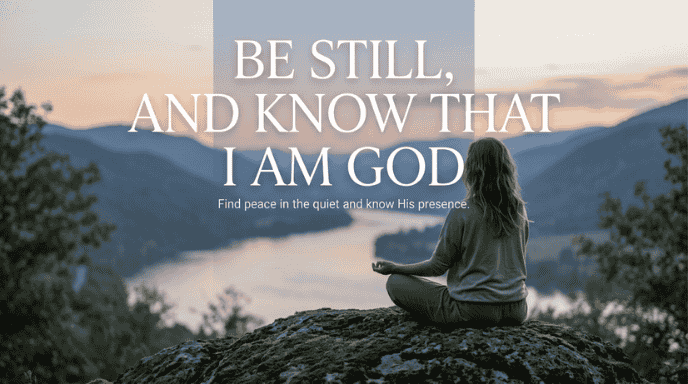
Be still, and know that I am God. Psalm 46:10 (Bible)
By: Psalm 46:10 (Bible) | Published on Mar 23,2026
Category Spiritual Quotes
About This Quote
This profound verse comes from Psalm 46, one of the most beloved psalms in the Hebrew Bible and Christian Old Testament. Written thousands of years ago, possibly during a time of war or national crisis, this psalm speaks of God as a refuge and strength. But verse 10 shifts from describing God's power to issuing a simple command: Be still. Stop striving. Stop fighting. Stop trying to control everything. Just be still and know.
The original Hebrew word translated as "be still" is "raphah," which means to let go, to release, to cease striving. It's not just physical stillness—it's the cessation of mental and emotional striving. The letting go of the need to control, to fix, to manage everything through your own effort. In that stillness, in that surrender, you remember what you've forgotten in all your striving: there is something greater than you, something divine, something that holds everything together even when you let go.
Why It Resonates
Think about how you live. You're constantly doing. Constantly striving. Constantly trying to control outcomes, manage situations, fix problems, make things happen through sheer force of will. You're holding everything together through effort, vigilance, and anxiety. You believe that if you stop, if you relax your grip, everything will fall apart.
And you're exhausted. Exhausted from the effort. Exhausted from the responsibility. Exhausted from believing that everything depends on you. You've made yourself the center of the universe—the one who must hold it all together. And it's crushing you.
Then you encounter this verse: "Be still, and know that I am God."
It's a command. But it's also an invitation. Stop. Just stop. Stop striving. Stop trying to control everything. Stop acting like you're the one holding the universe together. Be still. Let go. Surrender the illusion of control.
"And know that I am God"—in that stillness, you remember what you forgot in all your frantic doing: you are not God. You were never meant to hold everything together. You were never meant to control all outcomes. You were never meant to carry the weight of the world. There is something greater, something divine, something that existed before you and will exist after you, something that's actually in control even when you're not.
This resonates because you're so tired. Tired of the burden you were never meant to carry. Tired of the control you were never meant to have. Tired of the striving that never leads to peace. And this verse offers something radical: permission to stop. Permission to be still. Permission to surrender control and discover that everything doesn't fall apart when you do.
The Spiritual Wisdom Behind It
This teaching appears across spiritual traditions in different forms. In Buddhism, the concept of "letting go" is central—attachment and striving create suffering, while releasing creates peace. In Taoism, the principle of Wu Wei teaches effortless action—aligning with the natural flow rather than forcing outcomes. In Hinduism, the Bhagavad Gita teaches about detachment from results while performing your duty.
Christian mysticism has long emphasized contemplative prayer—sitting in silent stillness before God, not asking for anything, not striving for anything, just being present. Thomas Merton wrote: "The only true joy on earth is to escape from the prison of our own false self, and enter by love into union with the Life Who dwells and sings within the essence of every creature and in the core of our own souls."
Islamic Sufism teaches about fana—the annihilation of the ego and absorption into God. This happens not through effort but through surrender, through being still enough to experience the divine presence that was always there beneath your striving.
Modern spirituality speaks of "presence"—being fully here, now, without trying to control or change anything. Eckhart Tolle teaches that the present moment is the only reality, and in that present moment, when you're fully still and aware, you touch something eternal.
The universal truth across traditions: you cannot think your way to God. You cannot strive your way to spiritual truth. You cannot control your way to peace. These things are found in stillness, in surrender, in the gap between your thoughts and efforts. "Be still"—because the divine isn't found in the noise of your striving. It's found in the silence beneath it.
The Deeper Meaning
This verse is teaching you about the relationship between action and being, between striving and surrender, between your effort and grace. Western culture teaches you that everything depends on your effort. Your success is your doing. Your security is your achievement. Your worth is your accomplishment. So you strive endlessly, believing that if you just try hard enough, work long enough, control carefully enough, you'll finally find peace, security, meaning.
But this verse says: Stop. Be still. That path doesn't lead where you think it does. Peace isn't found in perfecting your striving—it's found in surrendering it.
"Be still"—this is a command to cease the striving. Not forever. Not to become passive or irresponsible. But to stop long enough to remember what's true. To let go long enough to discover that everything doesn't fall apart when you stop holding it together.
"And know that I am God"—this is the revelation that comes in stillness. When you stop trying to be God (the one who controls everything, knows everything, fixes everything), you remember that there is actually a God (something greater, something divine, something that holds reality together even when you let go).
The deeper wisdom is that your striving is often a symptom of spiritual amnesia. You've forgotten there's something greater than you. So you try to be that greater thing. You try to control everything because you've forgotten there's a God who's actually in control. You try to fix everything because you've forgotten there's a divine intelligence that's been orchestrating reality long before you were born.
"Be still, and know"—the knowing comes through stillness, not through thinking. You can't figure out God. You can't reason your way to spiritual truth. You can only be still enough to experience it. The divine reveals itself in the silence, in the gap, in the space you create by stopping.
Living This Truth
Create daily stillness. Not meditation as another task to accomplish, but simple stillness. Sit. Breathe. Do nothing. Let go of effort. Let go of trying to achieve anything, even "spiritual progress." Just be still.
Practice surrender in small ways. When you're holding tightly to control, notice it. Then practice letting go. "I cannot control this. There is something greater than me that's holding this." Not as a belief you force yourself to have, but as a truth you're willing to test.
Notice your God-playing. When you're acting like everything depends on you, when you're trying to control all outcomes, when you're carrying burdens you were never meant to carry—notice it. You're trying to be God instead of trusting God. Let that go.
Use this verse as a mantra. When anxiety rises, when control-urges grip you, when striving exhausts you—whisper this: "Be still, and know that I am God." Let it interrupt your striving. Let it remind you of what's true.
Trust the gaps. You've been filling every moment with doing, thinking, planning, controlling. Start trusting the gaps—the moments of doing nothing, knowing nothing, controlling nothing. In those gaps, something greater can be experienced.
And distinguish surrender from passivity. "Be still" doesn't mean stop acting responsibly. It means stop making yourself the center of the universe. Do your part, then surrender the outcome. Act with wisdom, then trust what's beyond your control. This is active surrender, not passive avoidance.
Your Reflection Today
Where in your life are you playing God—trying to control everything, fix everything, hold everything together through sheer effort?
What would happen if you were still for just five minutes today? If you stopped striving, stopped trying, stopped controlling—what might you discover in that stillness?
Can you trust that something greater than you is holding reality together, or do you believe everything depends on your constant effort?
Here's what this ancient psalm wants you to understand: You're exhausted because you're trying to be God. You're carrying burdens you were never meant to carry. You're trying to control outcomes you were never meant to control. You're holding everything together through constant effort when you were never meant to hold everything together.
And you can't see it because you never stop moving. You never stop striving. You never stop trying to manage and control and fix everything. So you never experience the truth that would free you: there is something greater than you. Something divine. Something that was holding reality together long before you were born and will continue holding it together long after you're gone.
But you have to be still to know this. You can't think your way to this truth. You can't strive your way to this peace. You can't control your way to this surrender.
You have to stop. Be still. Let go. Surrender the illusion that everything depends on you.
"Be still, and know that I am God."
Not "be still and figure out God." Not "be still and achieve God." Not "be still and control God." Just know. Experience. Remember what you forgot in all your striving.
You are not God. And that's not a problem—it's liberation. Because if you're not God, then you don't have to be God. You don't have to hold everything together. You don't have to control all outcomes. You don't have to know everything, fix everything, manage everything.
There is a God. Something greater. Something divine. Something that's actually in control even when you're not. Something that holds reality together even when you let go. Something that existed before your striving and will exist after it.
And you connect with that something not through more effort, but through stillness. Not through more control, but through surrender. Not through thinking harder, but through being still enough to know.
So today, right now, be still. Just for a moment. Let go of whatever you're trying to control. Stop whatever you're striving for. Surrender whatever burden you're carrying that's not yours to carry.
And in that stillness, that surrender, that space—know. Experience. Remember.
There is something greater than you. You are held. You are known. You are loved. Even when you stop trying. Especially when you stop trying.
Be still. And know.
That's the invitation. That's the command. That's the path to peace. 🙏✨
Amazon Affiliate Disclosure
As an Amazon Associate I earn from qualifying purchases.
Comments
No comment yet. Be the first to comment