
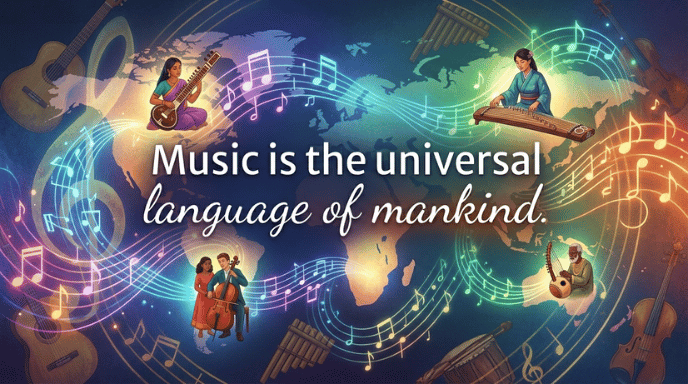
Music is the universal language of mankind.
By: Henry Wadsworth Longfellow | Published on Mar 28,2026
Category Quote of the Day
About This Quote
This beautiful observation comes from Henry Wadsworth Longfellow (1807-1882), one of America's most beloved poets. The quote appears in his 1835 novella "Outre-Mer: A Pilgrimage Beyond the Sea." Longfellow was a scholar of languages, fluent in several European tongues, and deeply familiar with the limitations and barriers that language creates between people. Yet he recognized that music transcends all those barriers.
Longfellow understood something profound: you can travel to a country where you don't speak the language, where you can't read the signs or understand conversations—and yet when music plays, something shifts. Suddenly, there's connection. Understanding. Shared emotion. Music speaks where words fail. It communicates what cannot be translated. It reaches the parts of human experience that language cannot touch.
Why It Resonates
Think about your relationship with music. It's been there your whole life, hasn't it? Your first memories probably have soundtracks. That song that reminds you of childhood. That album that got you through heartbreak. That melody that makes you think of someone you love. That rhythm that makes your body move without thinking.
Music doesn't ask permission to affect you. It doesn't need translation. It doesn't require explanation. A song from a culture you've never encountered, in a language you've never learned, can still make you cry, make you dance, make you feel something profound.
You've experienced this. A melody that captures exactly how you feel when you had no words for it. A rhythm that moves your body before your mind decides to move. A harmony that creates emotion you didn't know you were feeling. Lyrics in a language you don't speak that somehow communicate directly to your soul.
This is what Longfellow means by "universal language." Not that all music is the same or says the same thing. But that music has the ability to communicate directly to the human soul, bypassing the need for shared language, shared culture, or shared experience.
You can sit in a concert hall with a thousand strangers from a hundred different countries, speaking fifty different languages, coming from completely different lives—and when the music plays, something happens. You're not strangers anymore. You're humans together, feeling something together, experiencing something that transcends all the things that separate you.
The Science and Soul Behind It
Neuroscience has discovered that music activates more areas of the brain simultaneously than any other human activity. It engages the emotional centers, the movement centers, the memory centers, the language centers, the reward centers—all at once. Music is whole-brain activity. It's one of the most complex and integrated things the human brain can process.
There's fascinating research on how music affects us physiologically. It can lower blood pressure, reduce stress hormones, boost immune function, release dopamine and oxytocin. Music literally changes your body chemistry. It's not just subjective experience—it's measurable biological response.
Research on music and memory shows that music is one of the most powerful memory triggers. Alzheimer's patients who can't remember their own names can still sing songs from their youth. Music accesses memories that verbal language can't reach. It's stored differently, processed differently, preserved differently in the brain.
Studies on music across cultures reveal universal patterns—the way lullabies sound similar across completely unrelated cultures, the way certain rhythms create similar emotional responses worldwide, the way humans everywhere spontaneously create music. Music isn't learned from culture—culture is one expression of something deeper and universal in humans.
There's research on music and social bonding showing that making music together—singing, drumming, dancing—releases oxytocin and creates group cohesion more effectively than any other activity. This is why every human culture has music. It's a bonding mechanism, a way to create shared experience and connection.
Anthropological research shows that music predates language. Our ancestors were making music before they had complex language. Music is older than words. It's more fundamental to being human than speaking.
The Deeper Meaning
This quote is really about connection—how music creates bridges where words build walls. Language divides humanity. English speakers and Mandarin speakers cannot directly communicate. They need translation, interpretation, explanation. But music? Music communicates directly.
"Universal language" doesn't mean music says the same thing to everyone. It means music has the capacity to communicate across every human boundary. A Japanese person and a Brazilian person may interpret a piece of music differently, feel different things, think different thoughts—but both are having a direct, unmediated experience of that music. No translation needed. No explanation required.
Music speaks to something beneath language, beneath culture, beneath individual difference. It speaks to the human experience itself—joy, sorrow, longing, celebration, grief, love. These are universal human experiences, and music expresses them in ways that words cannot.
This is why you can hear a song in a language you don't speak and still feel exactly what the singer is feeling. The emotional communication happens through melody, harmony, rhythm, tone—not through the literal meaning of words. Music conveys the feeling behind words, even when you don't understand the words themselves.
The deeper wisdom is about what unites humanity versus what divides it. We have different languages, cultures, religions, political systems. These differences create barriers, misunderstandings, conflicts. But we all have music. Every culture, every people, every human society makes music. And while our music is different, the fact that we all make it, respond to it, need it—that's universal.
Music reminds us we're one species. One humanity. Experiencing the same range of emotions, facing the same existential questions, celebrating and grieving and longing and loving in ways that are fundamentally similar beneath all surface differences.
Living This Truth
Use music to process what words can't express. When you're feeling something you can't articulate, don't reach for words—reach for music. Let music say what you can't say. Let it express what you can't explain.
Let music connect you across differences. When you encounter someone from a completely different background, different culture, different language—share music. It's a bridge. A way to connect that doesn't require translation.
Pay attention to what music does to you. Notice how it changes your mood, your energy, your memories, your body. Music isn't just entertainment—it's a powerful tool for emotional regulation, memory access, and psychological wellbeing.
Make music, even if you're "not musical." Hum. Sing in the shower. Tap rhythms. Music-making isn't reserved for professionals—it's a human birthright. Making music together is how humans have bonded since before we had language.
Use music intentionally. Need energy? There's music for that. Need calm? There's music for that. Need to grieve? To celebrate? To focus? To remember? There's music for all of it. Music is medicine, if you use it that way.
And when words fail—in moments of profound joy, deep grief, overwhelming love, indescribable beauty—let music speak. Because there are human experiences that exist beyond language. And music is how we express them.
Your Reflection Today
What song or piece of music has communicated something to you that words never could?
When have you connected with someone across language or cultural barriers through shared music?
What emotion are you feeling right now that would be better expressed through music than through words?
Here's what Longfellow wants you to understand: Words are limited. They're specific to cultures, to languages, to particular ways of organizing reality. English divides the world differently than Mandarin. German has concepts that don't translate to French. Every language creates barriers even as it creates meaning.
But music? Music transcends all of that.
You can listen to traditional Japanese koto music and feel something, even if you've never been to Japan, never studied the culture, don't know the tradition. You can hear an African drum circle and your body moves, even if you've never encountered that particular rhythm pattern. You can listen to a Spanish guitar and experience longing, even if you don't speak Spanish.
Because music isn't communicating at the level of concepts and ideas. It's communicating at the level of feeling, emotion, experience. The human things. The universal things. The things we all know regardless of what language we speak or what culture we were born into.
Joy sounds a certain way. Grief sounds a certain way. Longing sounds a certain way. Love sounds a certain way. These aren't learned—they're human. And music expresses them in ways that translate across every boundary.
This is why music is so important. Why every culture creates it. Why humans have been making music for longer than we've been making language. Because we need a way to communicate the things that exist beyond words. The experiences that are too big, too deep, too complex for language to capture.
You know this in your own life. That song that perfectly captures how you feel, in ways you could never explain in words. That melody that brings back a memory so vivid, so complete, that it's like traveling through time. That rhythm that makes your body move before your conscious mind decides to dance.
Music is doing something words cannot do. It's speaking a language older than language. More fundamental than language. More universal than language.
You can't translate music. You can only experience it. And that experience—whether you're in Tokyo or New York, whether you speak English or Arabic, whether you're young or old, rich or poor—that experience is fundamentally human.
Music is the universal language of mankind because it speaks to what unites us, not what divides us. It expresses the human experience—all of it. The joy and the sorrow. The celebration and the grief. The hope and the despair. The love and the loss.
And it does this without needing translation. Without needing explanation. Without requiring shared culture or shared language or shared anything except shared humanity.
So when you're feeling something words can't capture—listen to music. When you need to connect with someone across barriers—share music. When you want to remember what unites humanity instead of what divides it—experience music.
Because music is the universal language of mankind.
And in a world of increasing division, of language barriers and cultural misunderstandings and political conflicts—we need to remember that we have a language we all speak.
Music. The language of the human soul. 🎵✨
Amazon Affiliate Disclosure
As an Amazon Associate I earn from qualifying purchases.
Comments
No comment yet. Be the first to comment