
The Story of the Farmer and His Horse
By: Ancient Taoist Parable | Published on Apr 18,2026
Category Moral Stories
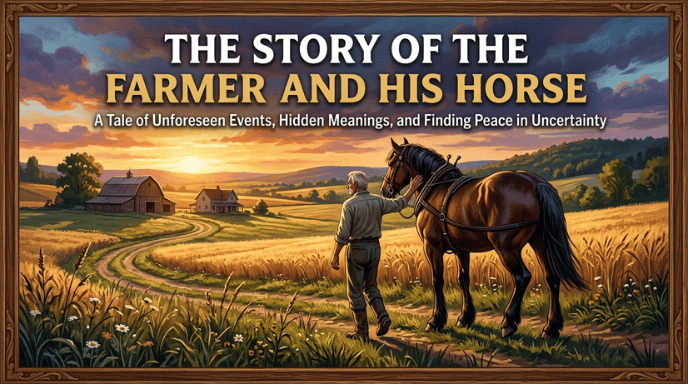
There was once a farmer who owned a beautiful horse. One day, the horse ran away into the hills. All the neighbors came to console him.
"What terrible luck!" they said.
The farmer replied calmly, "Maybe. Maybe not. We'll see."
A week later, the horse returned, bringing with it a herd of wild horses. The neighbors came again, this time to congratulate him.
"What wonderful luck!" they exclaimed.
The farmer replied, "Maybe. Maybe not. We'll see."
The next day, the farmer's son tried to ride one of the wild horses. He was thrown off and broke his leg badly. The neighbors came once more to offer sympathy.
"What terrible luck!" they said.
The farmer replied, "Maybe. Maybe not. We'll see."
A week later, military officers came to the village to draft all the young men into the army for a brutal war. Because of his broken leg, the farmer's son was spared. The neighbors came yet again.
"What wonderful luck!" they said.
The farmer smiled and replied, "Maybe. Maybe not. We'll see."
About This Story
This ancient parable comes from Taoist tradition, often attributed to the teachings found in the Zhuangzi or associated with Taoist philosophy. Variations of this story appear across Chinese philosophy and folklore, sometimes called "The Farmer's Luck" or "Sai Weng Lost His Horse" (塞翁失馬). The story has been told and retold for thousands of years because it captures a fundamental truth about life, perspective, and the nature of fortune and misfortune.
The farmer in this story isn't naive or in denial. He's deeply wise. He understands something that most people never learn: you cannot judge whether an event is good or bad in isolation. What seems like disaster often leads to blessing. What seems like blessing often leads to disaster. The farmer has learned not to judge too quickly, because life has a way of revealing hidden connections you couldn't see in the moment.
Why This Story Resonates
Think about how you react to events in your life. Something good happens—you celebrate. Something bad happens—you despair. You judge each event immediately: good luck or bad luck. Victory or defeat. Blessing or curse. And you react accordingly, with joy or devastation.
But here's what you discover over time: you were often wrong. The "terrible" thing that happened last year? It turned out to be exactly what you needed. It redirected your path in crucial ways. The "wonderful" thing that happened? It actually created problems you're still dealing with. What you thought was disaster was actually grace in disguise. What you thought was blessing was actually a trap.
You know this from your own life, don't you? The job you didn't get that you were devastated about—and then you found a better one. The relationship that ended that broke your heart—and then you met someone more compatible. The opportunity you thought you "missed"—and then you discovered it would have been wrong for you.
Or the reverse: the thing you were so excited about that turned into a nightmare. The success that brought unexpected problems. The victory that led to new struggles.
The farmer understands what you keep forgetting: you don't have enough perspective to judge whether something is good or bad in the moment it happens. You're seeing one scene in a long movie. You're reading one sentence in a long book. You don't know how the story unfolds yet.
This story resonates because you're exhausted from the emotional rollercoaster of judging events too quickly. Something happens, you declare it terrible, you spiral into anxiety. Something else happens, you declare it wonderful, you get attached. But the farmer offers a different way: "Maybe. Maybe not. We'll see."
The Philosophy Behind It
This story embodies core Taoist principles, particularly Wu Wei (effortless action) and the concept of yin and yang—how opposites contain each other, how fortune and misfortune are intertwined, how life flows in cycles that human judgment cannot fully comprehend.
The Tao Te Ching teaches: "Good fortune follows upon disaster; disaster lurks within good fortune. Who can say how things will end?" This is exactly what the farmer knows. He's not being pessimistic when good things happen or optimistic when bad things happen. He's simply refusing to judge prematurely.
This connects to Stoic philosophy as well. The Stoics taught that external events are "indifferent"—neither good nor bad in themselves. Only your judgments about them create suffering or peace. Marcus Aurelius wrote: "Choose not to be harmed—and you won't feel harmed. Don't feel harmed—and you haven't been."
Buddhism teaches about the "second arrow"—the first arrow is what happens to you (which you cannot control), the second arrow is your reaction to what happens (which you can control). Most of your suffering comes from the second arrow, from your judgments and reactions, not from the events themselves.
Modern psychology calls this "cognitive reframing"—the ability to view situations from different perspectives. Research shows that people who can reframe events, who don't rigidly attach to initial judgments, experience less anxiety and depression. They maintain emotional equilibrium because they're not constantly swinging between celebration and devastation.
The Deeper Meaning
This story has three profound layers of wisdom about judgment, perspective, and the interconnectedness of events.
The first layer is about the limits of human perspective. You cannot see the full picture. You're living in the middle of a story whose ending you don't know. Every event is connected to future events in ways you cannot yet perceive. Judging something as definitively good or bad is premature because you don't have the information yet.
The horse running away seems terrible—until it brings back wild horses. The wild horses seem wonderful—until one breaks the son's leg. The broken leg seems terrible—until it saves him from war. Each judgment is based on incomplete information. The farmer knows this, so he refuses to judge.
The second layer is about emotional equilibrium. The neighbors are on an emotional rollercoaster—devastated one day, ecstatic the next, devastated again, ecstatic again. The farmer maintains calm throughout. Not because he doesn't care, but because he doesn't attach to initial judgments. He's not numb—he's wise.
This is the path to peace: not controlling events (which is impossible), but controlling your judgments about events (which is possible). The farmer can't control whether the horse stays or leaves, whether his son gets injured, whether war comes. But he can control whether he declares these events as definitively good or bad. And by refusing to judge, he maintains peace.
The third layer is about trust in the larger pattern. The farmer's repeated "we'll see" isn't passivity—it's trust. Trust that life has patterns and connections beyond his immediate understanding. Trust that what seems like disaster might serve a purpose. Trust that he doesn't need to know the full story to live wisely in this chapter.
This is faith, in the deepest sense. Not religious faith necessarily, but trust in the larger unfolding of life. The farmer doesn't need to understand why things happen to maintain equilibrium. He trusts that there's a larger pattern, even when he can't see it.
Living This Truth
Practice "maybe, maybe not" when events occur. Something happens that seems terrible? "Maybe. Maybe not. We'll see." Something happens that seems wonderful? "Maybe. Maybe not. We'll see." This isn't pessimism or optimism—it's wisdom.
Notice your premature judgments. You're constantly declaring things "good" or "bad" without enough information. Catch yourself. "I'm judging this situation without knowing how it will unfold. I don't actually know if this is good or bad yet."
Look for examples in your past. Think of things you judged as terrible that turned out to be blessings. Things you judged as wonderful that turned out to be problems. Let your own history teach you that your immediate judgments are often wrong.
Separate facts from interpretations. The horse ran away—that's a fact. "This is terrible"—that's an interpretation. The son broke his leg—fact. "This is a disaster"—interpretation. Notice the difference. You can acknowledge facts without attaching dramatic interpretations.
Maintain emotional equilibrium. Don't celebrate too high or despair too low. Not because you don't care, but because you know you don't have the full picture yet. Save your emotional energy for when you have better perspective.
And trust the larger pattern. You don't need to understand why something happened to accept that it happened. You don't need to see the full story to live wisely in this chapter. Trust that events are connected in ways you can't yet see.
Your Reflection Today
What event in your past did you judge as terrible that turned out to be a blessing? What did you judge as wonderful that turned out to create problems?
What current situation are you judging too quickly—declaring it definitively good or bad without having the full picture?
Can you hold events more lightly, with "maybe, maybe not, we'll see" instead of immediate judgment?
Here's what this ancient story wants you to understand: You're judging too quickly. You're declaring things "good luck" or "bad luck" without nearly enough information. And those premature judgments are creating unnecessary suffering.
Something happens that seems bad. You immediately judge it as disaster. You spiral into anxiety, despair, victimhood. You tell everyone how terrible your luck is. You build an entire narrative about how this ruins everything.
And then, six months later, you discover that thing was actually necessary. It redirected you. It protected you. It opened doors you didn't know existed. What you judged as disaster was actually grace.
Or something happens that seems good. You immediately judge it as wonderful. You celebrate. You get attached. You tell everyone how lucky you are. You build your whole future around this good fortune.
And then, six months later, you discover that thing created problems. It took you in the wrong direction. It brought complications you didn't foresee. What you judged as blessing was actually a trap.
The farmer knows this pattern. He's lived long enough to see how fortune and misfortune intertwine, how today's disaster becomes tomorrow's blessing, how today's blessing becomes tomorrow's disaster. So he refuses to judge too quickly.
"Maybe. Maybe not. We'll see."
This isn't denial. This isn't toxic positivity ("everything happens for a reason!"). This isn't pessimism ("nothing good lasts!"). This is wisdom. The recognition that you don't have enough perspective to judge yet. The humility to admit you can't see the full picture. The peace that comes from not attaching to premature judgments.
Your horse ran away? Maybe that's terrible. Maybe that's exactly what needed to happen. You don't know yet. So why create suffering by declaring it definitively bad?
Your son broke his leg? Maybe that's a disaster. Maybe that's what saves his life. You don't know yet. So why despair over something that might turn out to be a hidden blessing?
You got the job? You got rejected? You met someone new? You lost someone important? You succeeded? You failed?
Maybe. Maybe not. We'll see.
This doesn't mean you don't feel emotions. This doesn't mean you don't respond to events. This means you hold your judgments lightly. You acknowledge what happened without declaring whether it's ultimately good or bad. Because you don't know yet.
Life is long. Events are connected in ways you can't see. What seems like disaster often becomes doorway. What seems like blessing often becomes burden.
The farmer knows this. So he maintains peace through it all. Not because nothing affects him, but because he refuses to judge without sufficient perspective.
That's wisdom. That's the path to emotional equilibrium. That's how you live through life's ups and downs without being destroyed by the rollercoaster.
Maybe. Maybe not. We'll see.
That's the only honest answer. The only wise response. The only way to maintain peace in a life where you cannot predict the future. 🐴🌾✨
The Moral
Don't judge events too quickly. What seems like disaster often contains hidden blessings. What seems like fortune often brings unexpected problems. Life unfolds in patterns beyond your immediate understanding. Practice "maybe, maybe not, we'll see"—holding judgments lightly until you have better perspective. This isn't pessimism or denial; it's wisdom. It's recognizing that you're living in the middle of a story whose ending you don't yet know.
Amazon Affiliate Disclosure
As an Amazon Associate I earn from qualifying purchases.
Comments
No comment yet. Be the first to comment