
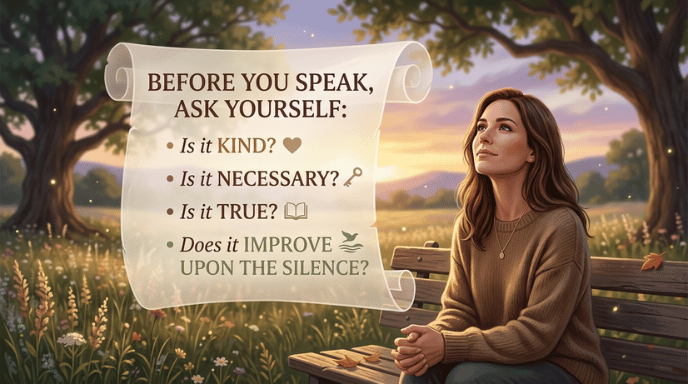
Before you speak, ask yourself: Is it kind, is it necessary, is it true, does it improve upon the silence?
By: Attributed to various sources (Sathya Sai Baba variation) | Published on May 20,2026
Category Spiritual Quotes
About This Quote
This powerful teaching about mindful speech appears in various forms across spiritual traditions. It's often attributed to Sathya Sai Baba, the Indian spiritual leader, though variations appear in Buddhist teachings, Sufi wisdom, and Quaker practice. The core concept—filtering speech through questions before speaking—is ancient and universal, appearing wherever wisdom traditions have emphasized the power and responsibility of words.
The quote presents four filters for speech: kindness, necessity, truth, and whether it improves upon silence. These aren't arbitrary criteria—they represent a comprehensive framework for understanding when words serve a purpose and when silence is wiser. Together, they create a practice of conscious speech that transforms communication from automatic reaction to deliberate choice.
Why It Resonates
Think about how you typically speak. Words flow out automatically. Someone says something, you respond immediately. You have a thought, you share it instantly. You feel an emotion, you express it without pause. Speaking is so automatic, so habitual, that you rarely question whether your words should be spoken at all.
And how many times have you regretted your words? Said something in anger you wish you could take back. Shared information that hurt someone unnecessarily. Spoken truth in a way that was cruel rather than kind. Filled silence with words that added nothing of value.
This quote is asking you to pause. To create space between impulse and speech. To filter your words through four essential questions before they leave your mouth. Is it kind? Is it necessary? Is it true? Does it improve upon the silence?
These aren't theoretical questions. They're practical filters that can transform your relationships, your reputation, and your own peace of mind. Because most of the words that cause problems fail at least one of these filters. The harsh criticism that's true but unkind. The gossip that's unnecessary even if true. The kind lie that's not honest. The small talk that adds nothing to the moment.
This resonates because you're tired of regretting your words. Tired of creating problems through careless speech. Tired of the way words can damage relationships, hurt people, and complicate life. You intuitively know that better speech starts with more thoughtful speech—and thoughtful speech starts with pausing to ask these questions.
The Spiritual Wisdom Behind It
In Buddhism, "Right Speech" is part of the Noble Eightfold Path. The Buddha taught that right speech means abstaining from lying, divisive speech, harsh speech, and idle chatter. These four filters—kind, necessary, true, improves upon silence—address exactly these categories.
In the Quaker tradition, there's the practice of "speaking when spoken through"—only speaking when there's a genuine spiritual prompting, not filling silence with unnecessary words. The question "does it improve upon the silence?" captures this practice perfectly.
Islamic tradition teaches "speak a good word or remain silent." Prophet Muhammad said: "Whoever believes in Allah and the Last Day should speak good or remain silent." The emphasis on silence as the default, with speech as the exception that must meet certain criteria, is universal in spiritual teaching.
In Sufism, there's a teaching: "Before you speak, let your words pass through three gates: Is it true? Is it necessary? Is it kind?" This is almost identical to the quote, showing how this wisdom transcends individual teachers or traditions.
The Hindu concept of "Satya" (truth) emphasizes not just factual accuracy but truth that's beneficial. Truth spoken to harm is violence, not virtue. This is why kindness appears alongside truth in these filters—truth without compassion is just cruelty wearing a righteous mask.
Modern psychology research on emotional regulation shows that the pause between stimulus and response—between thinking something and saying it—is where emotional intelligence lives. People with high emotional intelligence naturally filter their words through criteria like these.
The Deeper Meaning
This quote is teaching you that silence is the default, and speech is the exception that must be justified. Most people assume the opposite—that speaking is the default, and silence is what needs justification. But spiritually wise speech reverses this: silence is the baseline, and words must earn their way out of your mouth.
"Is it kind?"—This filter catches cruelty, harshness, and unnecessary pain. Truth can be spoken cruelly or compassionately. This question asks: even if my words are true and necessary, are they kind? Am I speaking to help or to hurt?
"Is it necessary?"—This filter catches gossip, idle chatter, and unnecessary information sharing. Just because something is true and you could say it doesn't mean you should. Is this information necessary for this person to hear? Does speaking serve any purpose beyond satisfying my urge to talk?
"Is it true?"—This filter catches lies, exaggerations, and misrepresentations. But it's not just about factual accuracy—it's about whether you're being honest about your motives, your knowledge, and the full context. Are you presenting truth, or using facts to create a false impression?
"Does it improve upon the silence?"—This is the ultimate filter. Even if your words are kind, necessary, and true, do they add value? Or would silence be more powerful, more respectful, more appropriate? Not all true, kind, necessary things need to be said. Sometimes silence is the wisest response.
The deeper wisdom is that most of your words fail at least one of these filters. And when words fail these filters, they create problems. They hurt people. They complicate situations. They damage trust. They waste time. They fill space without adding value.
But when your words pass all four filters? They become powerful. They build rather than destroy. They heal rather than harm. They illuminate rather than confuse. They add value rather than just adding noise.
Living This Truth
Practice the pause. Between thinking something and saying it, pause. Even just three seconds. In that pause, run your words through the filters. This feels awkward at first, but it becomes natural with practice.
Start with one filter. If four feels overwhelming, start with just "is it kind?" or "is it necessary?" Master one filter before adding others. Even filtering speech through a single question will transform your communication.
Notice when you fail the filters. You will speak words that aren't kind, necessary, true, or valuable. When you notice, learn from it. "That comment wasn't necessary—why did I feel compelled to say it?" Self-awareness about your speech patterns is the first step to changing them.
Embrace silence. Our culture treats silence as awkward, something to fill. But silence is often the wisest response. Not every thought deserves voice. Not every conversation needs contribution. Sometimes the most powerful thing you can do is simply be quiet.
Apply the filters to written communication too. Texts, emails, social media posts—all speech, not just verbal. Before you hit send, ask the questions. Is this kind? Necessary? True? Does it improve upon silence (or in this case, not posting)?
And when others speak unkindly, unnecessarily, untruthfully, or without adding value—recognize that their words have failed the filters. This helps you not take their words so personally. They're speaking from habit, not wisdom. They're words that shouldn't have been spoken in the first place.
Your Reflection Today
How much of what you've said today would pass all four filters—kind, necessary, true, and improving upon silence?
What words have you regretted speaking that failed one or more of these filters?
What would change in your relationships if you spoke only words that passed all four filters?
Here's what this spiritual wisdom wants you to understand: You're speaking too much. And most of what you're saying shouldn't be said. Not because you're a bad person, but because you're speaking from habit rather than consciousness. You're filling silence with words instead of letting silence be.
Before you speak, ask yourself these questions. Not once, not sometimes, not just for "important" conversations. Every time. Before every comment, every response, every statement.
Is it kind? Not just "not mean," but actively kind. Are these words spoken with compassion? Are you considering how they'll be received? Are you causing unnecessary pain?
Is it necessary? Not just interesting or true, but necessary. Does this person need this information? Does this conversation require your input? Or are you speaking just to speak?
Is it true? Not just "not a lie," but genuinely true. Are you presenting information honestly and completely? Are you being truthful about your motives? Are you representing reality accurately?
Does it improve upon the silence? This is the question that stops most speech. Because most of what you say doesn't improve upon silence. It just fills space. Adds noise. Interrupts quiet. The silence was fine. Your words didn't make it better.
If your words pass all four filters—kind, necessary, true, and improving upon silence—then speak them. They've earned their way out of your mouth. They deserve to be heard.
But if they fail even one filter? Stay silent. The silence is wiser than your words.
This practice will transform your life. Not gradually—immediately. Because when you start filtering your speech, you'll discover how much of what you say shouldn't be said. How many problems you've created through unnecessary words. How much peace there is in thoughtful silence.
Your relationships will improve. People will trust you more because you speak truth. They'll appreciate you more because you speak kindly. They'll seek you out because you don't waste their time with unnecessary words.
Your mind will quiet. Because speaking less means thinking less about what you're going to say, less replaying what you said, less worrying about how it was received.
Your spiritual practice will deepen. Because conscious speech is conscious living. Every filtered word is a moment of presence, of choice, of alignment with wisdom.
Before you speak, ask yourself: Is it kind, is it necessary, is it true, does it improve upon the silence?
Most of the time, the answer will be no. And that's when you stay silent.
Speak less. Mean more. Choose wisdom over habit. 🤐🙏✨
Amazon Affiliate Disclosure
As an Amazon Associate I earn from qualifying purchases.
Comments
No comment yet. Be the first to comment