
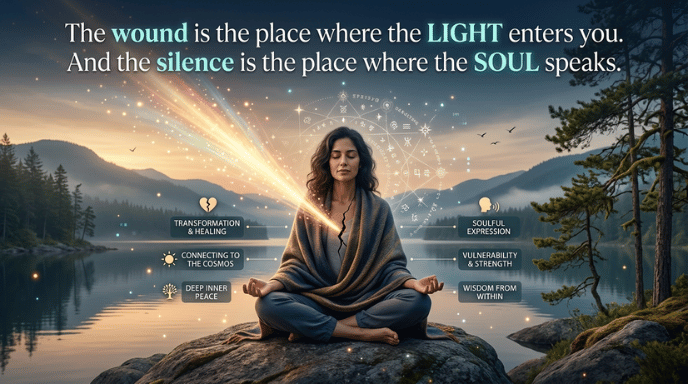
The wound is the place where the Light enters you. And the silence is the place where the Soul speaks.
By: Rumi and Sacred Wisdom Traditions | Published on Jun 19,2026
Category Spiritual Quotes
About This Quote
This teaching combines two profound spiritual truths: the first part from Rumi (which we explored elsewhere), and the second from the universal wisdom of contemplative traditions across religions. Together, they reveal the complete path of spiritual awakening: the wounds that break you open, and the silence that teaches you to listen.
In all spiritual traditions—Christian monasticism, Sufi mysticism, Zen Buddhism, Hindu Advaita Vedanta, Quaker practice—silence is understood as the language of the divine. Not silence as emptiness or absence, but silence as fullness. The space where the noise of ego, thought, and wanting ceases, and what remains is Soul—the deepest dimension of your being.
Why It Resonates
Think about your relationship with silence. You probably avoid it. When there's silence, you fill it—with music, podcasts, conversation, your phone. When your mind becomes quiet, you get anxious and start thinking intensely about problems, planning, worrying. You're afraid of silence. And spiritually, that fear is costing you everything.
Because the soul doesn't speak in words. It doesn't communicate through thoughts or language. It speaks in silence. In the space between thoughts. In the quiet. In the stillness. And if you never experience that silence—if you're constantly filling it with noise—your soul has nowhere to speak.
You've heard spiritual teachers talk about "going within," "listening to your inner voice," "connecting with your true self." But how do you do that while you're constantly consuming noise? How does the soul speak when you won't stop talking, won't stop thinking, won't stop filling the space with stimulation?
This quote is saying: the wounds open you. They crack you open to possibility. But the silence is where the actual transformation happens. In the silence, you stop defending. You stop performing. You stop trying to control or figure out. You stop being anyone other than who you actually are. And in that space, the soul—the deepest part of you, the divine within you—can finally speak.
This resonates because some part of you knows this is true. You've felt it in moments—in meditation, in nature, in prayer, in that moment before sleep, in those rare times when your mind is quiet. In those moments, something becomes clear. Something is known. Something shifts. The soul spoke. And you remember: yes, this. This is what I'm seeking.
The Spiritual Wisdom Behind It
In all mystical traditions, silence is where the divine is encountered. The Christian tradition speaks of "the still, small voice" of God—it's not loud, it's subtle, it requires silence to hear. The Desert Fathers and Christian monastics spent years in silent solitude to cultivate presence to God.
In Sufi Islam, there's the practice of khalwa (seclusion) and muraqaba (meditation)—deliberately entering silence and solitude to experience union with the divine. The Sufi saying: "The soul finds its rest in silence."
Buddhism teaches about "inner silence" (anatta, no-self) as the gateway to enlightenment. In Zen, practitioners sit in silent meditation for hours, waiting for the silence itself to teach. There's a saying: "The Buddha in silence preaches the loudest sermon."
Hindu Advaita Vedanta teaches that the deepest truth—Brahman, ultimate reality, the self—cannot be thought or spoken. It can only be realized in silence. "Neti, neti" (not this, not this)—the path is to remove all concepts and words until only silence remains, and in that silence, the self is known.
In Taoism, silence and stillness are the fundamental nature of the Tao. Lao Tzu taught: "The Tao that can be spoken is not the eternal Tao." Truth beyond words. Found in silence.
Modern neuroscience research on meditation shows that sustained silence and stillness literally change brain function—quieting the "default mode network" responsible for self-referential thinking, ego concerns, and endless mental chatter. In that silence, different neural networks activate—those associated with peace, integration, and what people describe as "the divine."
The Deeper Meaning
This quote is teaching that spiritual transformation has two essential components: opening and listening. The wounds open you. The silence is where you listen. Without both, the spiritual journey is incomplete.
"The wound is the place where the Light enters you"—wounds break you open, shatter your defenses, humble you. But the opening alone isn't transformation. Many people are broken and remain broken, hardened, bitter. The brokenness is just the beginning.
"And the silence is the place where the Soul speaks"—after you're opened by the wound, there must be silence. Space. Receptivity. The soul doesn't shout. It whispers. It speaks in stillness. It communicates through knowing beyond words, through intuition, through the felt sense of presence.
Without silence, you can't hear the soul speaking. You'll intellectualize the wound. You'll create stories about it. You'll think your way through it. But the soul doesn't communicate through thinking. It communicates through being.
The deeper wisdom is that spiritual transformation requires both breaking and listening, both opening and receiving. The wound does the breaking. The silence does the receiving. Both are necessary.
And crucially: the silence itself is the teacher. Not your thoughts about what the soul might say. Not words or concepts you create. The silence itself. The quality of presence in the silence. The peace that emerges when all noise ceases.
The soul doesn't speak in language—it speaks in recognition. In sudden knowing. In peace that passes understanding. In moments of such clarity that you can't doubt them, even though you can't explain them. This is what happens in silence. Not because the soul is saying words, but because in the silence, you finally listen.
Living This Truth
Create silence deliberately. Not once, but daily. Even 10 minutes of sitting in silence—no phone, no music, no distraction—can transform your connection to your soul. This isn't meditation necessarily (though it can be), it's just silence. Presence. Listening.
When you enter silence, expect nothing. Don't go in thinking "I'll have a spiritual experience" or "the soul will speak to me." Just sit. Be present. The soul doesn't perform on demand. But in silence, you create the space where it can emerge.
Notice what arises in silence. Thoughts, emotions, sensations, knowing. Don't judge it. Just notice. Sometimes the soul speaks as sudden clarity. Sometimes as peace. Sometimes as a knowing without words. Sometimes as an image, a feeling, or just a sense of rightness or wrongness about something.
Start small if silence feels scary. Silence can be anxiety-producing when you're used to constant noise. Start with 5 minutes. Let your nervous system adjust to the unfamiliar peace.
Notice when silence is most accessible. Early morning? Late night? In nature? After a wound? After crying? When you're alone? Create conditions that support silence in your life.
And take what the soul speaks into silence out into the world. The soul doesn't speak only so you can sit in silence. It speaks to guide your life. So listen in silence, then live it out.
Your Reflection Today
What prevents you from experiencing silence? Is it fear? Habit? Belief that you don't have time?
When was the last time you experienced true silence—no noise, no phone, no distraction—and what, if anything, did you notice?
What would your life be different if you created space for the soul to speak daily?
Here's what the spiritual traditions across time want you to understand: You're too loud. Your life is too loud. Your mind is too loud. And the soul cannot speak in the noise.
The wounds will come. Life will break you open if that's what's required for you to grow. The light will enter through the cracks. But what good is the light if you're not there to receive it? What good is the opening if you immediately fill it with more noise?
You go to spiritual teachers, read spiritual books, practice spiritual disciplines. You're seeking connection, seeking guidance, seeking the presence of the divine or your true self or ultimate truth—whatever language resonates for you.
But you won't find it in words. Not in these words. Not in anyone's words. Words point toward it, but they're not it. The actual experience—the actual presence of the soul—happens in silence.
The soul has been trying to speak to you. In those quiet moments. In meditation. In nature. In prayer. In the silence of just before sleep or just after waking. The soul has been speaking. But you haven't been listening because you haven't been in silence long enough to hear.
So the first spiritual practice isn't belief, or ritual, or studying texts. It's silence. Creating the space where the soul can be experienced.
Not thinking about the soul. Experiencing it. Not understanding it conceptually. Knowing it directly. This is what happens in silence.
The soul doesn't need you to understand it. It needs you to listen. And listening requires silence.
So start. Tomorrow. Sit in silence for 10 minutes. No phone, no music, no distraction. Just you and the silence. And listen.
Not for specific messages. Not for spiritual experiences. Just listen. Be present. Let the silence itself be the teacher.
The wound opens you. That's passive—life does that. But the silence is your choice. You must create it. You must protect it. You must choose to be present in it.
This is the spiritual practice that no one talks about because it's so simple, so available, so free, that we think it must not be the real practice. But it is.
Silence. Presence. Listening. This is where the soul speaks.
Everything else—all the teachings, all the practices, all the seeking—is just pointing back to this.
The wound is where the light enters. The silence is where the soul speaks. Both are necessary. The wounds will come. But the silence must be chosen.
Choose it. Today. 🤐✨🙏
Amazon Affiliate Disclosure
As an Amazon Associate I earn from qualifying purchases.
Comments
No comment yet. Be the first to comment